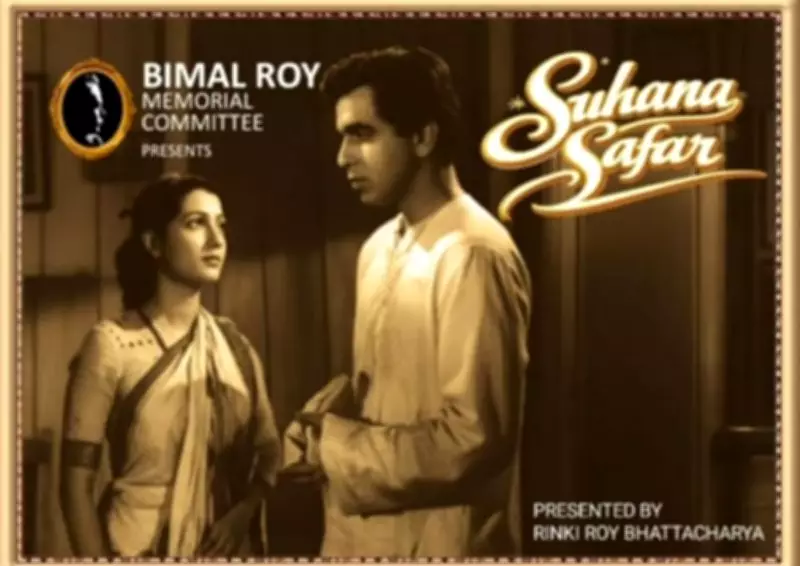
A new book titled 'Suhana Safar' documents the nearly 30-year journey of the Bimal Roy Memorial Committee (BRMC), founded by writer-filmmaker Rinki Roy Bhattacharya to honor the enduring legacy of her father, iconic director Bimal Roy.
Book Details
Blending personal reflections, critical essays, rare photographs, and archival material, 'Suhana Safar' moves between past and present, becoming both an archive and a meditation on film societies, collective memory, and the fragile continuity of cultural heritage.
The book is presented by Bhattacharya with contributions from filmmakers Roopa Barua and Sanjit Narwekar, film critic Maithili Rao, and other voices from the world of cinema and culture. Filmmaker-archivist Shivendra Singh Dungarpur has written the foreword.

Bimal Roy's Legacy
Roy directed celebrated classics including 'Do Bigha Zamin', 'Devdas', 'Bandini', 'Parineeta', and 'Madhumati'. He died in 1996.
BRMC's Work
The BRMC works to recognize unsung heroes of the film industry and holds retrospectives, musical evenings, festivals, and masterclasses featuring directors and actors from the 1950s to the present day, says Bhattacharya.
These annual events began in 1997. Renowned music arranger Manohari Singh orchestrated evocative evenings steeped in nostalgia, celebrating composers like Salil Chowdhury, S D Burman, and Jaydev. Concerts dedicated to lyricists such as Shailendra, Majrooh Sultanpuri, and Kaifi Azmi held audiences spellbound, evoking a time when music and poetry were inseparable from the emotional fabric of cinema.
In March 2001, BRMC paid tribute to Waheeda Rehman with a curated selection of her rare films. Alongside these were mini retrospectives featuring emerging voices such as Sabiha Sumar ('Khamosh Paani'), as well as international intersections with artists like Matthew Modine, with Ismail Merchant in attendance. A retrospective of Nutan's films in 2019 continued this dialogue.
Honoring Unsung Contributors
The committee's vision is to celebrate not only iconic figures but also the unsung architects of cinema—the technicians, lyricists, and craftsmen whose contributions often remain unacknowledged. This began with cinematographer Dilip Gupta and extended to figures such as R D Mathur, film historian Father Gaston George, and poster artist Diwakar Karkare.
The BRMC jury has also recognized emerging voices such as Vikramaditya Motwane, Neeraj Ghaywan, Juhi Chaturvedi, and Gitanjali Rao, with a jury composed of practitioners like Amol Palekar, Maithili Rao, Sanjit Narwekar, Amole Gupte, and Tigmanshu Dhulia.
Impact and Significance
Over these years, BRMC has played an important role in valorizing key figures in the landscape of Hindi films. It has curated retrospectives and musical evenings celebrating luminaries of Indian cinema and acknowledged the contribution of both unsung heroes and emerging talents, writes Dungarpur.
Barua says the BRMC musical gatherings, screenings, and retrospectives contribute a significant tome of knowledge of India's cinematic past, adding that memory and nostalgia have given momentum in furthering the works of societies like BRMC.