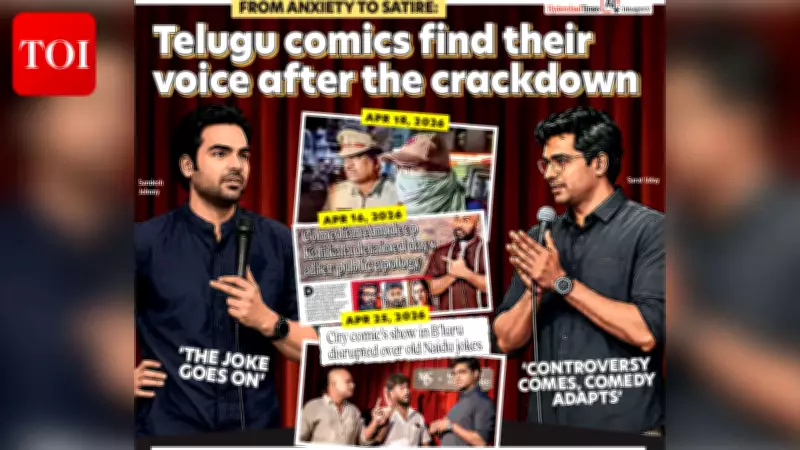
Humour has a way of cutting through the grimness, even in the most uncomfortable situations. For comedians in Telugu states navigating the increasingly sensitive intersections of politics and fandom, that tension has been particularly high lately. Earlier this year, comedian Anudeep Katikala faced intense backlash after a stand-up routine referencing Pawan Kalyan’s personal life went viral. Although Katikala quickly issued a public apology, the material ultimately led to his arrest. Within 48 hours, fellow comedian Rafiq Mohammed faced similar police action after video clips of his stand-up act, which also targeted the Deputy Chief Minister’s marriages, surfaced and circulated online. The swift back-to-back arrests triggered a wider debate around political humour, free expression, and the risks comedians face while performing.
Controversy Becomes Comedy
Two months later, the controversy itself has become part of the act. At a comedy festival organised by Communitie Hyderabad on Sunday, comedian Prasad, referring to the AP police action against Katikala and Mohammed, quipped: “They went all the way to Prayagraj and arrested them. We requested the police to leave them. The police said, ‘They joked about Pawan Kalyan. If they had joked about some other serious issue in society, we would have left them.’” The humour lay in the absurd reversal. The audience laughed, instantly. The joke had come full circle.
The event featured a lineup of Telugu stand-up comedians, digital creators, and surprise acts blending observational comedy and crowd work.

Fear and Resilience
“I think there’ll be a bit of both as we move forward — fear and resilience. Earlier, stand-up was quite niche, and only those familiar with it came to shows. But now, more people are aware of it, even if that’s because of these incidents in the Telugu space,” said Sandesh Johnn.
Testing New Boundaries
While the fallout from the April arrests loomed large over the festival, it wasn’t the only boundary local comics were willing to push. Anirudh used humour to highlight the lack of LGBTQ+ representation in Telugu cinema. Recalling a conversation with his father after watching the Malayalam film Kaathal – The Core, he pitched the idea of a mainstream Telugu film featuring a gay protagonist. He playfully imagined a veteran mass hero Nandamuri Balakrishna in the lead role, riffing on one of the actor’s iconic sci-fi movie titles to fit the premise.
Sandesh Johnny drew laughs from Hyderabad’s everyday realities, joking about over-crowded buses and a conductor who claimed passengers had once burnt buses because they wanted more of them.
What these sets made clear is that the crackdown hasn’t silenced local comics; it has simply forced them to sharpen their tools. Far from backing down, Telugu stand-up is proving that it can evolve past the headlines, finding new, layered ways to hold up a mirror to society.
Challenges of Raw Comedy
Performing stand-up here requires balancing the unfiltered nature of the craft with the region’s unique cultural realities. “One of the biggest challenges in the Telugu states is that cinema and politics are deeply intertwined. What may begin as a joke about films can quickly turn political, which often leads to faster and more intense backlash,” says Bhagat Anukanti, adding, “Many people are still not used to the rawness of stand-up as a medium, and political forces often tap into that discomfort by framing jokes as an attack on culture.”
Adversity has only honed their craft. Telugu comedians are pushing past the recent backlash, using smarter, layered humour to continue their social commentary.
“Unlike other industries, we don’t have the financial or institutional backing to fight prolonged legal battles. The Telugu stand-up scene is still relatively new. Without financial or institutional backing, that makes us pretty vulnerable,” says Vivek Muralidharan.

Political Humour Will Continue
Back in April, comedian Sandesh Johnny suggested that while certain jokes might become riskier, comedy would inevitably absorb the controversy itself. “Maybe comedians will not do the same kind of jokes anymore, like directly targeting someone’s personal life or body-shaming. But political humour will continue. In fact, this incident will become the joke now. That’s how comedians are. The funniest thing for me is that two policemen travelled all the way to Prayagraj. That itself becomes a joke. So it will never really go out of topic,” he said. The recent festival appeared to be an example of exactly that.
Vulnerability Without Backing
Operating without a safety net has forced local performers to evaluate the stakes of their material completely differently. “Unlike other industries, we don’t have the financial or institutional backing to fight prolonged legal battles. Most comics come from middle-class backgrounds, so naturally they will weigh the risks. The Telugu stand-up scene is still relatively new, which makes it more vulnerable,” says Vivek Muralidharan. He adds, “Comedy, at its core, is meant to say something. Audiences come to shows to laugh, to unwind, and sometimes to engage with ideas in a lighter way. They are not there to make political statements, yet they too get caught in the fallout. That defeats the purpose of the space entirely.”
Questioning Power
A recurring criticism of Telugu cinema is that many films have treated heroines as decorative props rather than fully developed characters. “These are the kinds of patterns in Telugu cinema that deserve critical examination,” says Sarat Uday. “I see stand-up comedy as one of the pillars of a functioning democracy. When comedy becomes more direct and reflective of reality, it makes people feel uncomfortable, and political forces often frame that discomfort as an attack on culture,” adds Bhagat Anukanti.
Public Reaction and Legal Recourse
For many within the creative community, the primary challenge isn’t the boundaries of the art form itself, but the volatility of public reception. “If you don’t like something, challenge it through dialogue or the law. How can anyone justify taking matters into their own hands?” she says, adding, “It raises a larger concern. At the moment, people react without context, but if something reaches the courts, at least there is a chance it will be evaluated fairly. That’s where such matters belong. Not in the hands of mobs.”
Anudeep, who was arrested over jokes on Pawan Kalyan earlier this year, took to the stage at the event with his signature comedic routine. “If people in power cannot be questioned, where does that leave us as citizens? Why is it acceptable to joke about ordinary people, but not those in power? A joke makes a point — that’s the whole purpose of it. Yet people ignore context entirely and react to fragments. They don’t care about the intent, only the reference,” says Sravanthi Basa.