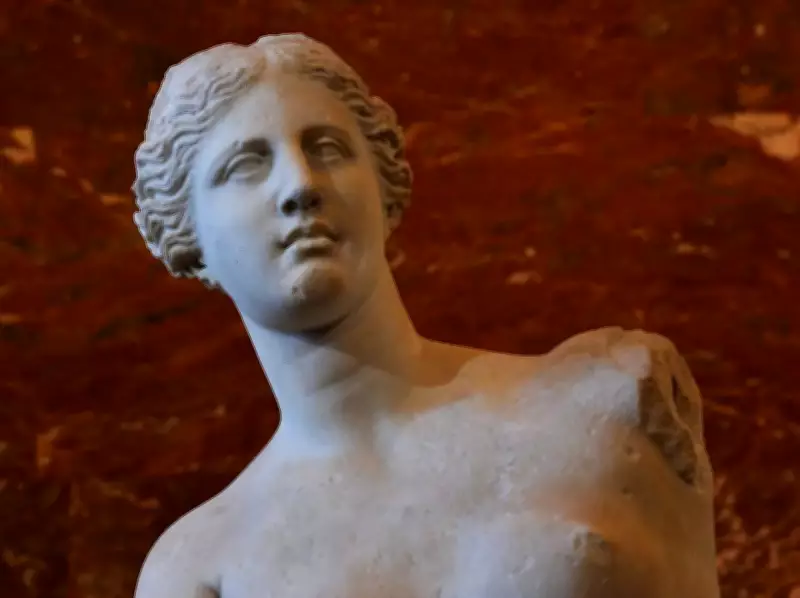
In April 1820, on the windswept mountainous terrain of the Greek island of Milos, a farmer named Yorgos Kentrotas was engaged in a timeless agricultural task: clearing stones from his soil to prepare it for planting. While prying loose a large rock near an ancient theater, he discovered a cavity beneath it. Inside, instead of treasure, he found the marble torso of a woman. The discovery immediately drew the attention of nearby French naval officers, who recognized the archaeological significance. They quickly recovered the fragments, which included the torso, draped legs, and some smaller parts, noting that the statue was unusually well-preserved compared to typical ancient stone rubble.
A Masterpiece Defined by Absence
According to the research paper A Masterpiece For The Modern Museum: The Venus De Milo, the statue's fame stems not only from what remains but also from what is missing. The Venus de Milo lacks limbs, not by artistic design but due to damage from burial or hasty removal from the island. This absence sparked global curiosity, raising questions about how the statue once held objects. Ironically, this imperfection shifted focus from idealized perfection to appreciating historical survivors. As noted in Creating the Past: The Vénus de Milo and the Hellenistic Reception of Classical Greece, the sculpture arrived in Paris at a pivotal moment when France had returned other stolen masterpieces and needed a new centerpiece for the Louvre. The Venus de Milo filled that void, setting a trend for exhibiting ancient sculptures as ruins of antiquity.
Transforming Cultural Perception
Kentrotas's find revolutionized the understanding of the Greek Hellenistic period. Before the Venus de Milo, ancient artworks were often perceived as static. However, this sculpture introduced dynamic features like torsion in the hips and the illusion of a slipping dress, showcasing a more lively artistic style. The statue's name itself is a historical paradox: Venus is the Roman goddess of love, but the artwork is unmistakably Greek, depicting Aphrodite. Scholars classify it as Greek art, highlighting how the history surrounding the artifact can be as intriguing as the sculpture itself. This layered history reminds us that simple artifacts can hold complex narratives.

Today, the Venus de Milo remains one of the most visited artifacts in the world, housed in its own gallery at the Louvre Museum in Paris. Yorgos Kentrotas, merely clearing his field, inadvertently offered humanity a glimpse into a lost Mediterranean era that continues to fascinate. The thought that a farmer's routine work could yield an enduring mystery for centuries is truly remarkable.
This article is adapted from the TOI Science Desk, a team of journalists dedicated to bringing captivating science news to readers of The Times of India.