India is often described by its extremes — chaotic roads, bustling markets, endless traffic jams, sensory overload, and sheer unpredictability. Yet, for many visitors, it is the people of India who leave the most lasting impressions.
The Viral Observation
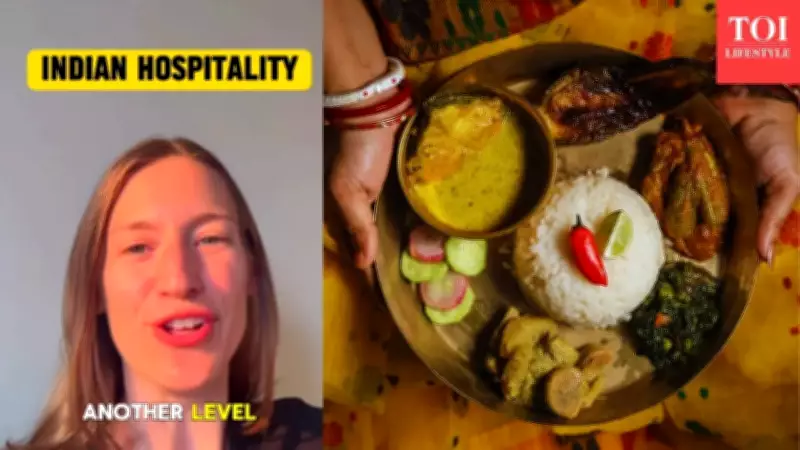
This sentiment recently resurfaced online when an American tourist, known on Instagram as @spicygori, shared a simple yet profound observation about Indian hospitality. In her video, she focuses not on tourist attractions but on everyday interactions with ordinary people that transformed her perspective on the country.
“People talk about Indian hospitality, but I really didn’t understand it until I experienced it,” she says. “When I go to someone’s house, they immediately offer chai, snacks, or ask ‘have you eaten?’ On trains, people just start sharing their food with me. If I look even a bit lost, someone comes and helps me.”

What makes her observation striking is the attention given to mundane actions that many Indians take for granted. Offering tea to guests, insisting that others eat more, giving directions to a stranger, or sharing home-cooked meals during train journeys — these are common practices. However, for outsiders, such encounters carry a uniquely personal touch.
The Essence of Indian Hospitality
The video quickly gained popularity because it captures something that tourists in India often experience but struggle to articulate. Hospitality in India is not polished or formalized. Instead, it emerges in the most chaotic settings — a family inviting a traveler for dinner, strangers helping at a railway station, or locals selflessly solving a problem.
For many foreign travelers, India can initially feel overwhelming due to its fast pace, crowds, and lack of privacy. Yet, gradually, they realize that the same culture that appears chaotic on the surface is also deeply considerate of others.
Indian hospitality blurs the line between stranger and guest. In many societies, hospitality is reserved for invited guests. But in Indian culture, it is extended to all visitors — friends, relatives, or even strangers met during a journey.
The Train Travel Example
A perfect illustration is the Indian railway experience. Train travel fosters a unique culture where passengers strike up conversations, share food, and treat entire compartments as small communities. Travelers often receive snacks, fruits, tea, or full meals from fellow passengers simply out of goodwill and a desire to ensure no one travels alone on an empty stomach.
The phrase “Have you eaten?” itself reveals the nature of care in India. Rather than a literal question about hunger, it is a formality deeply embedded in family and community culture. Offering food is seen as an act of kindness, and refusing it can sometimes be harder for the visitor than accepting the meal.
Spontaneity Over Commercialism
What makes these moments so memorable for travelers is their spontaneity. Unlike in countries heavily saturated by tourism, where friendliness can be tied to financial gain, Indian society offers hospitality without any commercial interest.
Of course, not everyone finds the experience effortless. Patience, flexibility, and a tolerance for surprises are essential when visiting India. Yet, the impression of encountering a deeply humane society amid the chaos stays with most visitors.
Remarkably, this form of hospitality is rarely highlighted in tourism promotions. Indian tourism often focuses on palaces, spirituality, culture, wildlife, or festivals. However, travelers frequently mention people, not places, as their fondest memories.
Small Acts, Big Impact
Consider these examples: a shopkeeper refusing extra payment, a family’s concern to ensure a traveler arrived safely, or a stranger guiding a lost passenger to the correct platform instead of just pointing the way. Individually insignificant, but collectively, these instances shape travelers’ perceptions of India.
This likely explains why @spicygori’s post resonated with so many online. It neither glorified India nor overlooked its problems. Instead, it acknowledged what is real and visible in the country.

India may not offer comfort in a traditional sense to most travelers. What it does offer is something rare in modern tourism: the reassurance that people genuinely care for one another.