

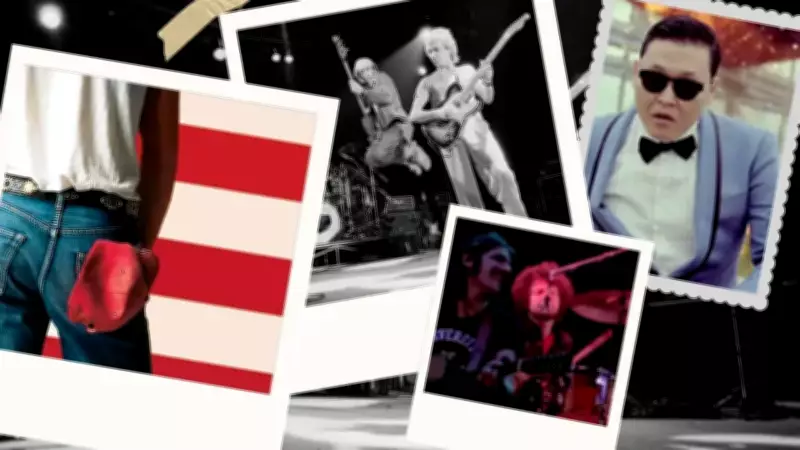
At parties, people belt out 'Born in the USA' like a chest-thumping patriotic anthem and slow-dance to 'Every Breath You Take' as though it were just a love song. Rarely does anyone stop to think about a war veteran abandoned by his country in one, or the unsettling obsession lurking beneath the romance in the other. Somewhere between radio play, nostalgia, and dance floors, songs often lose the stories they were written to tell.
Take 'Hotel California'. Released in 1976, the Eagles classic remains one of rock music's most enduring singalongs. For decades, listeners have been hypnotised by its dreamy guitars and haunting refrain: "You can check out any time you like, but you can never leave." Yet the song was never simply about a mysterious hotel. Songwriters Don Henley, Glenn Frey, and Don Felder conceived it as a commentary on excess, illusion, and the dark underbelly of the American dream. "It was our interpretation of the high life in LA," Henley later explained.
And that is the curious afterlife of popular music: the catchier the chorus, the easier it becomes to miss the meaning. Beneath irresistible hooks and stadium-ready melodies often lie stories of heartbreak, alienation, anxiety, and social critique. Here are some of the world's most misunderstood songs.

Born in the USA – Bruce Springsteen (1984)
'Born in the USA' remains rock's greatest con — a song so euphorically loud that almost nobody heard what it was actually saying. Springsteen wrote it as a gut-punch: a Vietnam war veteran comes home to find his country has moved on without him. The factories won't have him. The government won't help him. The verses say it plainly — "Went down to see my V.A. man / He said, son, don't you understand" — but the chorus hits so hard and so triumphantly that the despair simply drowns. What Springsteen intended as defiance, the world heard as celebration.
Conservative columnist George Will declared it a "cheerful affirmation" of American greatness in a September 1984 Washington Post column. The then-president of the US, Ronald Reagan, campaigning for re-election in 1984, invoked Springsteen's songs of "hope" at a rally — perhaps the most spectacular misreading in rock history. The man singing about war veterans with nowhere to go had accidentally become the soundtrack of morning-in-America optimism. Springsteen eventually ran out of patience. On a solo tour, he stripped the song down to a slow, mournful dirge — no E Street Band, no bombast, no escape route. Just the words, raw and unavoidable.
Every Breath You Take – The Police (1983)
It plays at weddings. It tops Greatest Love Songs playlists. Sting has spent decades baffled by both. "Every Breath You Take" is not a love song. Sting wrote it during a painful divorce, and the clue, he later admitted, was hiding in plain sight: "I'll be watching you" is not a vow — it's a threat. The melody is so gentle, the language so plain, that listeners floated past the surveillance and straight into the romance. Sociologist Gary Marx famously mapped the song's lyrics onto actual surveillance technology — breath analysers, motion detectors, wiretaps, ankle monitors — and found a near-perfect match. What Sting had written, almost instinctively, was a portrait of obsession and control dressed in a lover's language. The most sinister lines, it turns out, are the ones that sound the most beautiful.
Gangnam Style – Psy (2012)
Gangnam Style became a global viral sensation in 2012, largely seen as a goofy dance track with an addictive horse-riding move. But beneath the comic visuals and catchy beat lay a sharp satire of wealth, status, and aspirational culture in South Korea. The song mocks the flashy lifestyle of Seoul's ultra-rich Gangnam district — a symbol of conspicuous consumption so concentrated that the neighbourhood accounts for seven percent of the country's entire GDP. Psy's exaggerated swagger and over-the-top confidence are intentionally ridiculous, exposing the hollowness of performative wealth. Every glamorous setting in the video is deliberately undercut: the beach is a sandbox, the nightclub is a tourist bus, the red carpet is a parking garage in a snowstorm. The horse-dance wasn't absurdist filler — it was the punchline. The world danced along, entirely unaware it was the butt of the joke.

We Didn't Start the Fire – Billy Joel (1989)
It is, by most accounts, the song people sing most confidently while understanding least. The words come fast, the beat is propulsive, and somewhere between Harry Truman and Rock and Roller Cola Wars, most listeners stop processing and just enjoy the ride. "We Didn't Start the Fire" is a four-minute history of the world's worst four decades — nearly 120 political crises, cultural flashpoints, and civilisational anxieties crammed into a karaoke-friendly pop track. Joel wrote it after a younger acquaintance claimed that "nothing happened" in the 1950s. Stung by the ignorance, he began listing events: the Korean War, the Hungarian Revolution, McCarthyism, the H-bomb, JFK. The chorus isn't a boast — it's a plea. One generation insisting it inherited chaos rather than created it. The fire, it turns out, was always burning. Most people just hummed along to the flames.
Pumped Up Kicks – Foster the People (2010)
"Pumped Up Kicks" arrived in 2010 wrapped in a breezy melody, a whistling hook, and a beat so danceable it became a party staple almost immediately. Which made it all the more unsettling once you listened closely. The song is written from the perspective of a troubled, isolated teenager fantasising about violence against his more privileged peers. Its famous chorus — "You better run, better run, outrun my gun" — is not playful exaggeration. Frontman Mark Foster later said the track was inspired by growing concerns around teenage mental health and school shootings. What millions mistook for carefree indie-pop was a portrait of alienation and suppressed rage dressed up in the sunniest production of the year.
American Pie – Don McLean (1971)
"Bye bye, Miss American Pie…" might be the ultimate singalong chorus, but beneath the campfire nostalgia lies a eulogy for innocence itself. Don McLean's sprawling 1971 epic was inspired by the 1959 plane crash that killed Buddy Holly, Ritchie Valens, and The Big Bopper — the tragedy he immortalised as "the day the music died." Over eight minutes, the song became a mournful scrapbook of America losing its youthful optimism, stitched with cryptic nods to Bob Dylan, the Cold War, political assassinations, and the cultural chaos of the 1960s. Beneath the cheerful "drove my Chevy to the levee" energy sits a quiet, devastating realisation: the party was ending, and America knew it. McLean has largely refused to decode the symbolism, which has only deepened the song's mystique — and ensured that most people keep singing the chorus without ever reckoning with what it mourns.
Delilah – Tom Jones (1968)
Tom Jones's 1968 hit "Delilah" is perhaps the most cheerfully sung murder ballad in history — a crime-of-passion confession dressed in the clothes of a pub anthem. The protagonist catches his lover with another man, waits outside her door all night, and when she answers laughing, produces a knife. "She laughed no more," Jones bellows, and the crowd roars its approval. The song became the unofficial anthem of Welsh rugby, Stoke City football club's terrace favourite, and grandmothers' go-to karaoke number — all without anyone apparently reading the lyrics too carefully. It took until 2015 for the Principality Stadium to quietly drop it from its half-time playlist, and a full ban on choirs performing it followed in 2023. Tom Jones himself initially thought it was a comedy record. Sixty thousand fans singing a stabbing to the tune of a drinking song suggests he wasn't entirely wrong.
Under the Bridge – Red Hot Chili Peppers (1992)
"Under the Bridge" sounds, on first listen, like a tender love letter to Los Angeles -- soulful, aching, quietly beautiful. It is not. Anthony Kiedis wrote it during a period of profound depression, three years into sobriety and feeling entirely estranged from his bandmates who continued to use drugs. The bridge of the title is not a metaphor — it is a specific location in downtown Los Angeles where Kiedis once ventured into gang territory to buy heroin, gaining access by falsely claiming a gang member's sister was his fiancée. The song is a visceral reckoning with the shame and isolation of addiction, disguised as a city serenade. Los Angeles, in Kiedis's telling, was the only thing that hadn't abandoned him at his lowest — which says rather a lot about how low that was.
Hey Ya! – Outkast (2003)
Few songs have tricked an audience quite as efficiently as "Hey Ya!". Released in 2003, it became one of the most irresistible dance tracks of its decade — the kind of song that empties a dance floor onto itself. Which is exactly what André 3000 predicted, and quietly resented. He wrote the track as a meditation on the slow decay of loveless relationships — couples staying together not out of affection but out of sheer inability to leave. The lyrics describe the quiet collapse of romance with unflinching clarity, before arriving at the conclusion that "separate's always better when there's feelings involved." André even called out his audience mid-song: "Y'all don't hear me, you just wanna dance." He was, of course, entirely correct.
Dancing in the Moonlight – Thin Lizzy (1977)
Here is a song with an identity crisis built in before anyone even presses play. Phil Lynott's "Dancing in the Moonlight" is shadowed by real trauma, Lynott's is warm, nostalgic, and affectionate — a street-level snapshot of young romance, the kind of easy, unguarded joy that Lynott, for all his rock-star swagger, returned to again and again in his writing. The confusion is compounded by the song's vocal style — intimate, conversational, unhurried — which leads many listeners to assume they are hearing Van Morrison. They are not. They are hearing one of rock's most underrated romantics doing what he did best: making the ordinary sound luminous.
