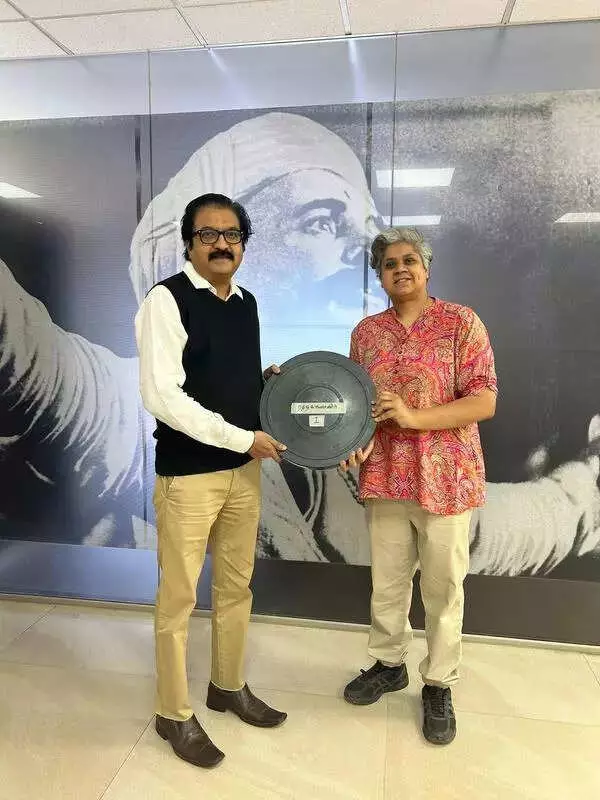
A significant piece of Indian cinematic history has been secured for future generations. A rare, original 35mm print of the acclaimed 1954 Tamil film "Ratha Kanneer" has been formally added to the collection of the National Film Archive of India (NFAI) in Pune. This acquisition underscores the critical and ongoing mission to rescue classic films from the risk of being lost in private collections or degraded through poor-quality digital copies.
A Passionate Donation Saves a Classic
The precious copy was donated by Aparna Subramanyam, a film research officer at the Film and Television Institute of India (FTII). Subramanyam handed over eight jumbo reels of the film in the 35mm format from her personal collection. Prakash Magdum, the Managing Director of the National Film Development Corporation, hailed the donation as a major step for the archive. He emphasized that archiving is a continuous, long-term effort, especially in a country like India where depositing films with the national archive is not a legal requirement.
"We are always on the lookout for rare films to be deposited at the archive," Magdum stated. "Outreach becomes essential. We have to keep appealing to production houses and individual collectors." He noted that while many collectors preserve films out of pure passion, their collections often face an uncertain future. "After they are gone, nobody knows what happens to the material. Our effort is to convince them to deposit it here, where it can be preserved and made useful for researchers and film lovers," Magdum explained.

Why 'Ratha Kanneer' is a Cinematic Treasure
Magdum described "Ratha Kanneer" as a particularly important find. "It is a rare film from the 1950s. You can imagine its impact even today. Clips from the film still circulate widely online," he said. The film, starring the legendary MR Radha, features a narrative that was bold for its time. Radha plays a foreign-returned man who displays indifference towards Indian values before undergoing a sharp realization. The film is known for its satirical tone, catchy dialogues, and progressive themes.
Magdum credited Aparna Subramanyam's role as crucial in locating the print. "She is an archivist. Because of her passion, she encouraged film lovers and distributors from south India to come forward with the material," he said. He added that the emergence of such a rare film provides the archive with an opportunity to renew its public appeal for more donations.
The Road to Restoration and Public Access
The newly acquired film print will now enter a detailed technical assessment phase at the NFAI. "We first check the condition and quality of the analogue material. After that, we clean it and carry out all necessary preservation steps," Magdum detailed. Following this, the archive will explore digital restoration to ensure the film's longevity. The goal, according to Magdum, is to improve the picture and sound quality while staying as faithful as possible to the original, retaining the film's distinct identity.
The timeline for this restoration depends entirely on the physical condition of the reels. "If the quality is good, it can take two to three months. Otherwise, four to five months," Magdum estimated. Once restored, the film will be made accessible for various purposes, including special screenings, academic research, and exploration by cinephiles. The archive also plans to add subtitles to make this classic accessible to wider, non-Tamil speaking audiences across India and the world. "This is how films remain alive," Magdum concluded, highlighting the ultimate purpose of preservation.