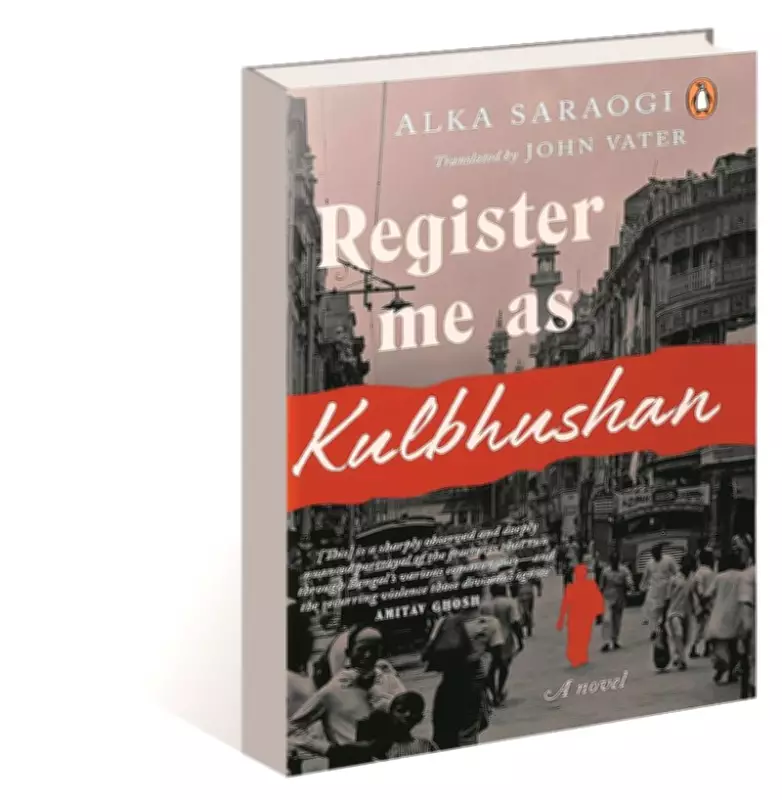
A Haunting Tale of Displacement and Identity
Alka Saraogi's novel 'Register Me As Kulbhushan', translated by John Vater, stands out in a season brimming with Partition stories. Evocative, expansive, and unsettling, it captures in fiction the facts largely lost in the history of the deliberate weeding out of Hindus from East Bengal. The book explores the power of memory—its fragility, as well as the inability to forget.
The story follows Kulbhushan Jain, an ageing refugee walking the streets of Calcutta when he sees a poster for a play titled 'Autobiography', which promises to be 'the epic of the final years of the 20th century'. This jolts him to revisit his own story of leaving his home in Kushtia, now in Bangladesh, and settling in a new country, searching for belonging.

The Protagonist's Struggle Within His Own Family
As the youngest son of a wealthy Marwari family, Kulbhushan's appearance determines his fate, making him a perpetual outsider. A 'muddy brown' complexion and features described as both 'overblown' and sunken give him a clownish appearance. To make matters worse, Bhushan Chacha is known to be light-fingered and works as a lowly bus conductor.
A vegetarian Jain married to a mutton-eating Bengali woman, Kulbhushan is the ultimate black sheep. 'My "kul" (clan) can go to hell!' he writes. Within his own family, his only tool for survival is servility. He prefers the English word 'love' over the Hindi word 'prem', honestly believing that Indians do not know how to love—they only know how to horse-trade.
Adopting a New Identity
Eventually, Kulbhushan chooses to adopt the identity of Gopal Chandra Das to live in a Bengali neighbourhood in Calcutta. He also possesses a unique 'superpower'. His closest friend Shyama, a dhobi who is just as unattractive as him, taught him a mantra to forget painful memories simply by punching an imaginary 'button'. An outsider himself, Shyama belongs to neither Hindu nor Muslim faith; he was an orphan adopted by his parents.
The novel flits between the lives of these two friends: Kulbhushan, who leaves for Calcutta, and Shyama, who stays behind.
The Setting: Kushtia and Calcutta
Saraogi sets the book between Kushtia, in the aftermath of the madness of Partition, and Calcutta, a city inundated by refugees after 1947. Once a sleepy, picturesque town on the banks of the Gorai river, Kushtia is the cultural capital of Bangladesh. It is home to Rabindranath Tagore's country estate and the mazar (shrine) of the mystic poet Fakir Lalon Shah, whose words still survive in Baul songs: 'The neighbours gossip, "That Lalon Fakir—Muslim or Hindu?" / Lalon says, "Fret not, I haven't got a clue!"'
It is this very harmonious space that is ripped apart during Partition. Fuelled by violence and hate, Kushtia is systematically emptied of its wealthy Hindu community over the years, with major exoduses occurring in 1964 and 1971.
Blending Fact with Fiction
Saraogi, a fifth-generation Marwari, blends facts with fiction to chronicle how her community was targeted. She recreates the turbulent years for families who owned factories. Their fear is palpable, yet they refuse to leave until no other choice remains.
We see this through Kulbhushan's friend, Anil Mukherjee, who stayed behind. He rescues his wife and daughter during the riots in Narayanganj, but the trauma of the night turns them into the living dead. His daughter is left to live with horrific memories—a narrative straight out of Saadat Hasan Manto's brutal short story 'Khol Do'.
Then there is Shyama's mentor, Kartik Babu, who elevated him from a dhobi to his personal rickshaw-puller. Chosen to represent the Pakistan Jute Mill Association, Kartik Babu chooses to stay behind while his brothers flee to India, only to be branded an enemy of the state and jailed.
Raw Survival, Not Resilient Triumph
As Kulbhushan becomes Gopal Das to blend into a Bengali neighbourhood, he is surrounded by Bangals (migrants from East Bengal) who are actively resented and isolated. Much like the Punjabi refugees in Delhi, they are treated as unwanted outsiders. This is not a novel about resilient triumph, but rather about raw survival.

Saraogi does not shy away from depicting the bloodiness of war or the grim reality of life in refugee camps. Acute hunger forces young girls to sell themselves for a spoonful of sugar. Hope, if at all, lies in the kindness of strangers.
Generational Trauma and a Lingering Question
'Register Me As Kulbhushan' brings with devastating intensity the sheer weight of grief and the scars of generational trauma. Nearly 80 years after Partition, these fractures still exist, driven by an 'intractable distrust' burrowed deep within the subconscious.
Ultimately, the novel leaves us with a lingering, universal question: amidst displacement and betrayal, where is home, and how do we truly belong?