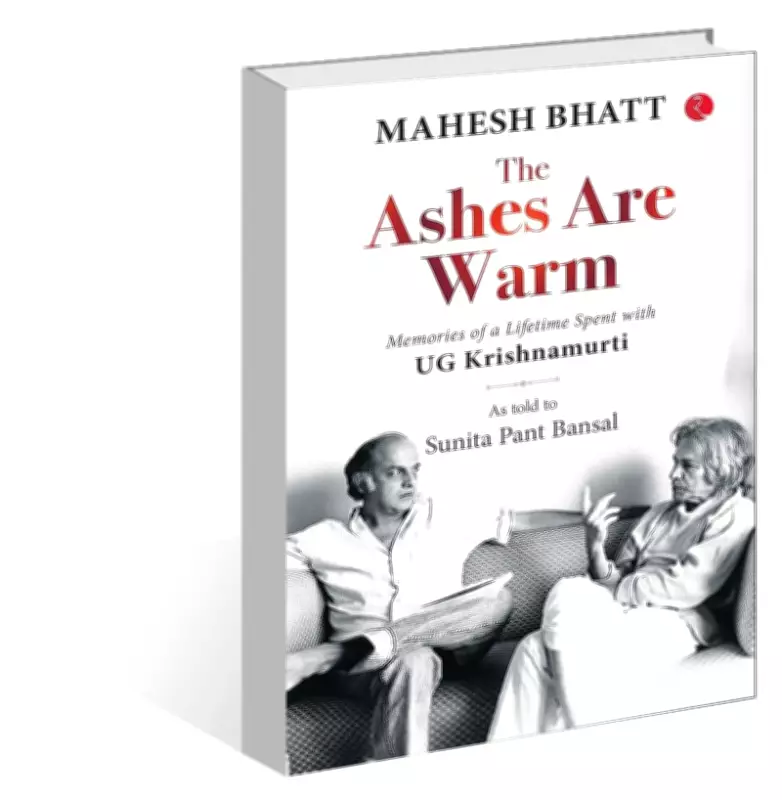
Filmmaker Mahesh Bhatt's latest book, 'The Ashes are Warm: Memories of a Lifetime Spent with UG Krishnamurti', is as much about Bhatt himself as it is about the controversial philosopher. Published by Rupa and spanning 366 pages at Rs 495, the book is presented as an honest memoir, but it often reveals more about Bhatt's ego and personal struggles than about UG.
Background of a Complex Relationship
Bhatt's relationship with UG Krishnamurti, known as the 'anti-guru' who rejected all beliefs and gurus, began in the 1970s. Bhatt, trapped in emotional and existential crises, found profound liberation through UG's teachings. The book traces this journey, starting with regular chapters and moving into diary-like musings, with UG as the central 'fire'.
To understand the bond, one must grasp Bhatt's personal background—born to parents of different faiths, he faced a non-canonical upbringing that shaped his secular and humanitarian stance. This political outlook, endorsed by UG, is the most satisfying aspect of the book, according to reviewer Harjinder Singh.

UG's Philosophy and Bhatt's Thirst
UG Krishnamurti's philosophy rejected organized religion, gurus, and psychological self-improvement, viewing enlightenment as a natural biological state. Bhatt embraced this, describing his own state as a 'spiritual coma'. In a chapter titled 'UG left — Only Thirst Remains', Bhatt writes, “The thirst for truth, for dissolution, for home – for a place where nothing inside me needs to pose or pretend.”
Bhatt quotes UG on death: “The body is a fortuitous concourse of atoms. There is no death for the body, only an exchange of atoms... In reality, nothing is born and nothing is dead.” After UG's death in 2007, Bhatt was left with this all-pervading thirst.
Self-Centric Narrative and Ego
While the book claims to be about UG, it focuses heavily on Bhatt's own successes, mentoring, and relationships. The reviewer notes, 'He writes, seemingly innocently, but with ego galore.' Bhatt details his friendship with UG, which began when he was 26 and lasted 33 years, but the narrative often veers into self-aggrandizement.
For instance, Bhatt writes about his inability to stay for the birth of his second child: “The idea of birth — of bringing life into a world that was already coming undone — was too much for me.” Such passages are described as 'remorseless, vane apathy of an intellectual celebrity'.
Portrayal of Women and Moral Pretence
The book's treatment of women is particularly problematic. Bhatt confesses to betraying his wife, but the other woman—a victim of communal violence and schizophrenia who died horribly—is portrayed as a mere archetype. The reviewer criticizes: 'Men (some of them, not all) are bad, not because of affairs, but because they think they can get away by taking a self-denouncing public stance decades after.'
Bhatt's mother, who lived a life of syncretism, receives more respect, and her influence on his worldview and films is acknowledged.
Diary Entries and Trivia
The diary sections are well-arranged, with private letters scanned and reproduced. However, the reviewer argues that such books appeal to privileged readers who find trivia profound. 'A lot of trivia appears profound to them,' he writes, adding that serious reading reveals 'the mundane lives of the rich and privileged.'
Despite occasional gems for the uninitiated, the book ultimately shows that both UG and Bhatt are ordinary humans seeking solace. The overwhelming grief in 'The Ashes are Warm' is palpable, but the reviewer concludes that Bhatt's true legacy lies in his films, like 'Arth' (1982), not this memoir.