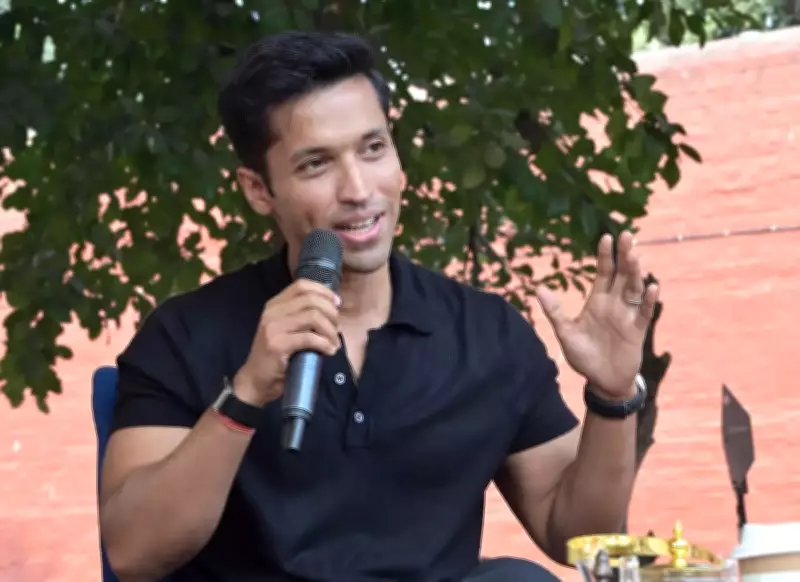
On a vibrant Sunday at the International Kolkata Book Fair, bestselling author Durjoy Datta engaged in a thought-provoking dialogue with actor Rahul Dev Bose during the Kolkata Literature Festival. Their conversation delved deep into the intricate anatomy of love as it evolves within our digitally saturated world, moving from relationships once characterized by simplicity to today's landscape overflowing with choices and connections.
The Digital Dating Dilemma: When Freedom Becomes Fatigue
The discussion explored how social media platforms, dating applications, and constant connectivity have fundamentally rewritten the traditional rules of intimacy and romantic engagement. Datta presented a compelling argument that while modern dating appears more accessible than ever before, this surface-level ease conceals deeper psychological complexities.
Dating Apps and the 'Buyer's Remorse' Phenomenon
"Dating has become incredibly easy to initiate. Dating applications have made access virtually effortless," Datta observed during the session. However, he emphasized that this convenience is deliberately engineered rather than accidental. "These platforms are constructed by highly intelligent individuals whose primary objective is capturing and retaining user attention. Consequently, we all fall into that carefully designed trap."

The author explained that the consequence of this intentional design is an overwhelming overload of options, which subtly alters how people perceive and approach human connection. "It mirrors the 'buyer's remorse' psychology perfectly," Datta noted. "Once someone begins conversing with a potential partner, there's almost an immediate internal questioning about whether you should simultaneously be exploring conversations with other individuals as well."
What initially appears as unprecedented freedom frequently transforms into emotional exhaustion. "While that might seem acceptable superficially," Datta continued, "numerous people are now recognizing how draining this perpetual cycle becomes," particularly because "it often fails to lead anywhere meaningful, leaving individuals going on first dates with different people for months without substantial progress."
At the core of this contemporary challenge, Datta suggested, lies technology that humanity is still learning to navigate responsibly. "This represents new technology, and we're all attempting to comprehend how it genuinely affects our emotional lives," he admitted. "We believe we can manage it effectively, but the reality is we haven't yet developed the necessary skills to do so."
Emotional Honesty: The Unchanging Human Element
Durjoy Datta openly credited the current generation for its enhanced emotional awareness, stating, "One aspect I genuinely admire about this generation is their expanded vocabulary for discussing relationships." Unlike previous generations, he believes contemporary individuals are "more discerning about the relationships they wish to enter," demonstrating greater consciousness and deliberation in their romantic choices.
The Double-Edged Sword of Relationship Terminology
Yet, the author cautioned that this proliferating language surrounding love carries inherent risks. "Simultaneously," Datta added, "these relationship terms have become both fascinating and potentially dangerous," because specific words can sometimes mask what people remain unwilling to confront directly.
"The fundamental problem persists: we've always been somewhat dishonest in matters of love," Datta acknowledged, pointing out that romantic hesitation stems less from confusion and more from underlying fear. When someone is questioned about whether they're in a committed relationship or a casual situationship, "the person responding typically pauses"—not due to emotional ambiguity but because "they desire the connection to continue developing."
In that vulnerable moment, "they provide an answer that feels psychologically safe," even though "that response subsequently creates specific expectations. The issue isn't the terminology itself—it's the hesitation and apprehension behind selecting particular labels."

Strip away contemporary relationship classifications, Datta argued, and the essential emotional dynamics remain remarkably unchanged. "Human nature hasn't transformed. People have always been somewhat vague and occasionally dishonest in romantic contexts," he asserted. Within every relationship, "someone invariably loves more intensely, someone is always slightly ahead emotionally," and no quantity of new terminology can erase that inherent imbalance.
Self-Help Literature and Survivorship Bias
Durjoy Datta reflected thoughtfully on his extensive exploration of self-help literature, revealing, "During 2018-2019, I believe I read every significant self-help book published that year and listened to numerous audiobooks, ultimately realizing that most self-help books essentially represent photocopies of one another. Once you've absorbed the major works like Atomic Habits and similar titles, you recognize that every writer is fundamentally conveying identical principles."
He also highlighted the powerful influence of survivorship bias within this genre and warned that this bias can create deceptive illusions of personal transformation. "It might feel like you're genuinely changing your life, but in reality, substantial change may not be occurring. Therefore, there exists a definite limit to how far self-help books can transport you through time, making it crucial that you read them with appropriate caution and critical perspective."
Cultural Observations and Generational Shifts
Datta offered insightful comparisons between past and present relationship paradigms: "Previously, when you entered a relationship, circumstances were simpler. You were either single, in a committed relationship, or in what we casually termed a complicated relationship. That essentially covered all possibilities. Today, even if someone experiences relationship complications, they possess an extensive vocabulary to describe it precisely. The language surrounding relationships has expanded tremendously."
Regarding modern dating advantages, he noted: "In contemporary dating, more options exist, and that isn't inherently negative. Actually, in multiple respects, it's beneficial. You can communicate with more people, explore diverse conversations, and respectfully withdraw if something proves incompatible."
Discussing generational attitudes toward emotional expression, Datta observed: "For today's generation, displaying excessive affection is frequently perceived as cringe-worthy, yet adopting an overly cynical stance is also considered immature. A peculiar balancing act is constantly in play."
Personal Connection to Kolkata's Literary Culture
Sharing his personal affinity for Kolkata, Datta reminisced: "My parents spent most of their lives in Delhi but consistently mentioned that upon retirement they would settle in Kolkata, and I often wondered why. As I've matured, I've realized that I've gradually started spending increasing time in the city I once believed I had moved beyond."
He expressed admiration for Kolkata's unique literary culture: "Only in Kolkata could 300,000 to 400,000 people enthusiastically line up at a book fair. This remains a city profoundly connected to the enduring culture of reading and intellectual engagement."
The engaging session at the Kolkata Literature Festival provided audiences with profound insights into how digital transformation intersects with timeless human emotions, offering both critique and appreciation for how contemporary society navigates the complex terrain of love and connection.