

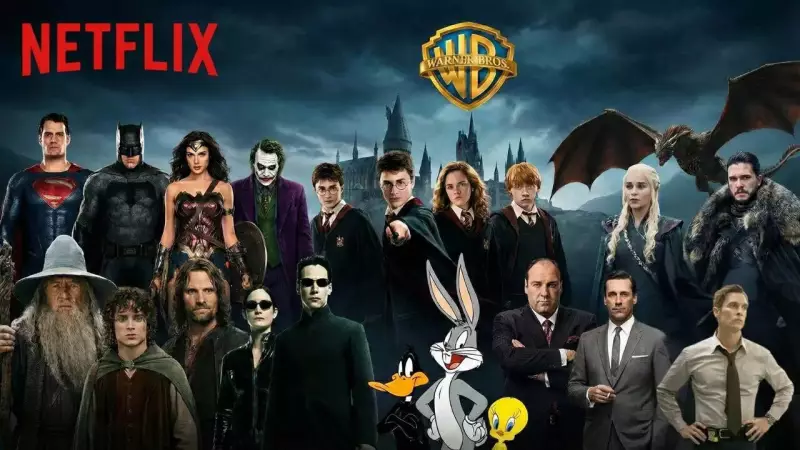
In a move that redefines the future of entertainment, Netflix, the company that began by mailing DVDs in red envelopes, is set to acquire the legendary Warner Bros studio. The deal, valued at an enterprise value of roughly $82.7 billion, signals a seismic shift where streaming officially becomes the centre of the entertainment universe, absorbing a century of cinematic history.
From Late Fees to Legacy: The Netflix Journey
Netflix's origin story is a classic tale of disruption. Born in the 1990s from frustration with video rental store late fees and limited selections, it offered a simple alternative: DVDs by mail. Its true transformation began in 2007 with the launch of streaming, a gamble on broadband infrastructure that paid off spectacularly. Hits like Stranger Things and Squid Game turned it into a global cultural force. However, a key weakness remained: unlike legacy studios, it lacked a deep vault of timeless intellectual property to anchor its subscription business for generations.
The Warner Bros Empire: A Century of Storytelling
The acquisition target, Warner Bros, is the bedrock of modern Hollywood. Founded in 1923, it pioneered sound in cinema with The Jazz Singer. Its catalogue is a tapestry of global culture, encompassing classics like Casablanca and The Wizard of Oz, blockbuster franchises like Harry Potter, DC superheroes, and The Lord of the Rings (via New Line). Its television arm, HBO, revolutionised the small screen with era-defining series like The Sopranos, Game of Thrones, and Succession, while shows like Friends and The Big Bang Theory became syndication staples worldwide.

Why This Deal Changes Everything for Netflix and Hollywood
The transaction solves Netflix's core challenges in one bold stroke. First, it instantly acquires a generational library, filling the "heritage gap" with franchises that can be rebooted and monetised for decades. Second, Netflix gains Warner Bros' global theatrical infrastructure—soundstages, distribution networks, and release expertise—ending its uneasy relationship with cinemas and allowing it to operate as a full-spectrum studio. Third, it gains ultimate control over high-value IP, from release windows to merchandising, blending its viewer data with Warner's creative prowess.
Financially, the numbers are staggering. The equity value is around $72 billion, with shareholders receiving a mix of cash and Netflix stock valued at about $27.75 per share. Netflix forecasts annual cost savings of $2 to $3 billion within three years. Notably, Warner Bros Discovery will spin off its linear networks (CNN, Discovery channels) into a separate entity before the deal closes; Netflix is buying the creative and streaming heart of the empire.
A New Three-Pole World and the Disney Challenge
This acquisition fundamentally alters the competitive landscape. For the first time, Disney's franchise supremacy—built on Marvel, Star Wars, and Pixar—faces a direct challenger with comparable scale. Netflix will now counter with DC, Harry Potter, and Game of Thrones universes. The streaming ecosystem consolidates into a three-pole system: Netflix-Warner, Disney, and Amazon-MGM.
For other players like Paramount and NBCUniversal's Peacock, the pressure intensifies. Without libraries of similar depth, mid-sized studios face tough choices between specialisation, merger, or sale to remain viable. The era where streaming was an insurgent force is over; it is now the industry's organising principle.
The Future for Audiences and Creators
Viewers can expect iconic films and HBO's prestige slate to eventually coexist with Netflix originals under one subscription, increasing convenience. However, this consolidation also raises questions about future pricing and market competition. For creators, Netflix-Warner becomes the world's most powerful buyer of content, capable of greenlighting ambitious projects. Yet, the merger also means fewer independent bidders and a potential culture clash between HBO's creator-driven model and Netflix's data-centric approach.

This is more than a corporate transaction; it's a hinge moment in entertainment history. The company that sought to escape the tyranny of the video store is now the custodian of Hollywood's golden-age memory and the architect of its future. The battle for audience attention will no longer be just about the next hit show, but about who controls the enduring narrative universes that define global culture.
