

Morning Beverage Turns Deadly in Andhra Pradesh Colony
In a quiet colony of East Godavari, Andhra Pradesh, what began as a typical morning quickly descended into horror. Families awoke, kitchens buzzed with activity, and the familiar ritual of preparing tea and coffee unfolded. However, within hours, this daily routine transformed into a devastating tragedy. Residents who had consumed their morning drinks suddenly fell ill, reporting symptoms like nausea, dizziness, and severe discomfort.
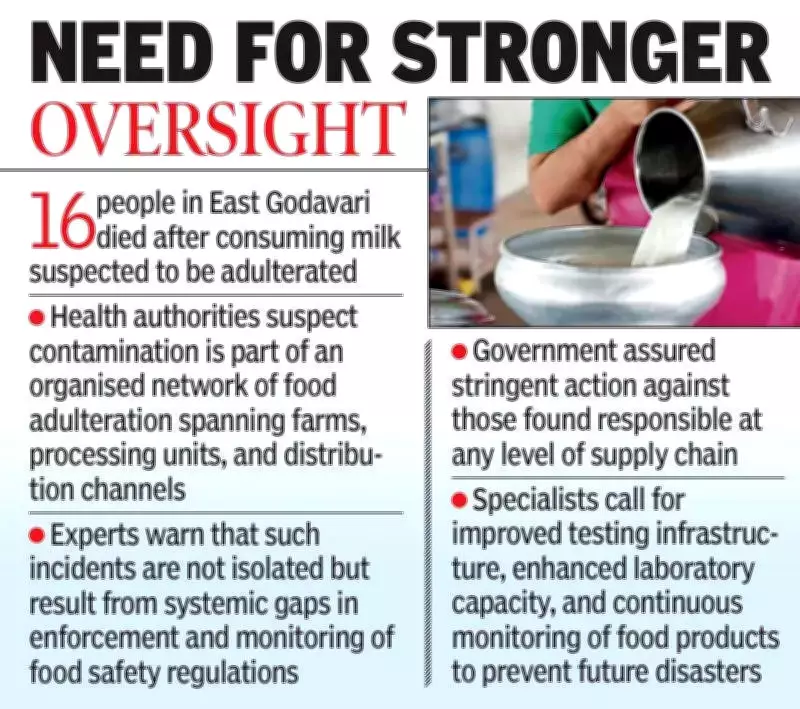
Panic erupted as individuals collapsed one after another in the small neighbourhood. By the time medical assistance arrived, it was tragically too late for many. Approximately 16 people lost their lives, with suspicions pointing to adulterated milk as the cause. This shocking incident has starkly revealed the lethal consequences of food adulteration in the region, where what might seem like a supply chain failure is increasingly viewed as part of a larger, organised problem.
From Regulatory Violation to Organised Crime
While food adulteration has often been treated merely as a regulatory breach, the deaths in East Godavari underscore a far more dangerous reality. Experts assert that adulteration is not an isolated act but a complex, multi-layered network. This network spans from farms to processing units and distribution channels, with contamination possible at numerous points before products reach households.

Amid rising concerns, Health Minister Satya Kumar Yadav has pledged strict action. He stated, "We will implement stringent measures to prevent such incidents. Those responsible at any level will face serious consequences," indicating a government crackdown. Interestingly, Maharashtra is considering using tough laws like the Maharashtra Control of Organised Crime Act (MCOCA) to address food adulteration as organised crime. Unlike standard food safety regulations, such laws target entire networks—including suppliers, financiers, and distributors—enabling asset seizures, longer prison terms, and more thorough investigations.
Industry Insights Highlight Systemic Failures
Industry perspectives further emphasize the scale of this issue. Equinox Labs, which tests thousands of food samples annually across India, has a firsthand view of how organised adulteration has become. Its CEO and founder, Ashwin Bhadri, explains that food adulteration now operates through structured networks rather than isolated actors. He stresses that recognising it as organised crime is a crucial step, but adds that enforcement must be supported by robust testing infrastructure and continuous monitoring to create effective deterrence.
Bhadri notes that gaps in enforcement allow adulteration to persist quietly until it escalates into public health disasters, as witnessed in East Godavari. There is now a growing demand for urgent, systemic reforms. Experts outline three critical steps that cannot be delayed:
- Enforcing stricter legal frameworks across states to target organised food crime.
- Strengthening testing infrastructure and laboratory capacity.
- Creating end-to-end traceability in the food supply chain for early detection.
Bhadri remarked, "The larger goal must be a shift from penalty-driven compliance to criminal accountability, where food fraud is treated with the seriousness it deserves."
A Grim Reminder and Call for Accountability
Back in the small colony of East Godavari, the silence now tells a sorrowful tale. Homes that started the day with the comforting aromas of tea and coffee are now mourning lost loved ones. This tragedy serves as a stark reminder that food safety transcends regulations—it is fundamentally about protecting lives. The pressing question is not only whether stricter laws will be enacted but whether society will demand accountability strong enough to ensure that a simple morning cup never again turns fatal.






