

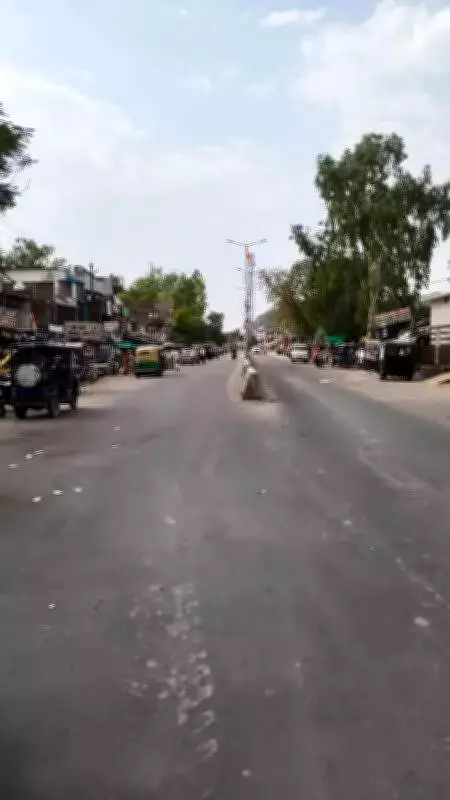
Banda, a town in Uttar Pradesh's Bundelkhand region, is enduring an extreme heatwave with temperatures soaring above 48 degrees Celsius. The heat is not just a seasonal discomfort but a matter of survival for its population of 1,799,410. By noon, streets empty, shops close, and children are confined indoors as fans circulate only hot air. For days, this town has been hotter than Middle Eastern deserts, with air resembling a blast furnace. Metal surfaces burn, tap water runs warm, and nights offer little respite as the ground radiates heat. While the record of 49.2 degrees Celsius from 2019 remains unbroken, temperatures of 47 and 48 degrees have become common. By 11 am, life retreats indoors.
Local Survival Strategies
Banda has developed its own methods to combat the grueling heat. By 11 am, markets in villages like Pangara, Naraini, and Atarra begin to close. In narrow lanes, traders sprinkle water outside their shops, hoping evaporation will briefly soften the heat. Families drag hoses to terraces to soak concrete roofs before nightfall, making rooms below barely habitable. Walls are repainted with limestone to absorb heat. Laxmi Narayan, a local resident, says, 'The rituals are old, but the desperation feels new.' He adds, 'By noon, the crowd on the streets disappears as life retreats indoors. Shop shutters clang down earlier than usual. Tea stalls fall silent. Rickshaw pullers vanish into pockets of shade.'
Night-Time Struggles
In Naraini, where power cuts and frequent tripping persist, sleep has become a negotiation with sweat. Aditya Tiwari, a trader, describes, 'Entire families carry charpoys onto terraces after dark, hoping for a breeze. Many pour water directly onto the floor before lying down, turning homes into makeshift cooling chambers for a few fleeting minutes.' He adds, 'We avoid venturing out in the blazing sun as much as possible. If we have to, we keep wiping our forehead with a wet gamcha.'

Impact on Livelihoods
Mornings begin unnaturally early for many. Vegetable vendors finish rounds before noon, and construction workers retreat by afternoon. However, for daily wage laborers, heat is unavoidable. In the evenings, as temperatures drop from unbearable to merely brutal, neighborhoods slowly come alive. Conversations resume on charpoys, and men gather at paan kiosks. Nikhil Yadav, a pharmacist, says, 'I open shop at 7 am and close by noon. I return only after sunset. Survival comes first, money can wait.'
Health Concerns
At Banda district hospital, doctors report a familiar procession of dehydration, dizziness, and exhaustion. Oral rehydration salts vanish quickly from pharmacy shelves. Watermelons, cucumbers, and earthen matkas have become both commodity and comfort. The weather office has forecast that 'heatwave to severe heatwave' conditions are likely to continue over southern districts of Uttar Pradesh for the next three to four days, particularly in Bundelkhand, with little immediate relief expected.
Administrative Measures
To help residents battle the relentless heat, the administration has installed 'pyaus' (public drinking water kiosks) across the town and at the railway station. At the bustling Kutchery crossing, authorities have set up a makeshift resting shelter fitted with coolers, offering passersby a brief escape from the searing afternoon sun.
Model Heat Action Plan
After the devastating 2010 heatwave, the Ahmedabad Municipal Corporation and partners launched India's first Heat Action Plan in 2013. Updated periodically, the plan guides extreme heat planning with an early warning system. Its main goal is to alert vulnerable groups when extreme heat hits and ensure precautions are taken. It also covers long-term steps like the Ahmedabad Cool Roofs Program. A 2018 study found the plan helped avoid an estimated 2,380 deaths. Key components include public awareness, early warning systems, capacity building, reducing heat exposure, promoting adaptive measures, and launching cool roofs programs.
About the Author: Ankur Tewari is a footloose disposition, shopaholic at heart, and a deskman by chance. He forages through the city's marketplaces for the best merchandise and stories. A pure vegetarian, everything non-vegetarian is non grata to him. His stories, on the contrary, are more diverse and cross-cultural.






