

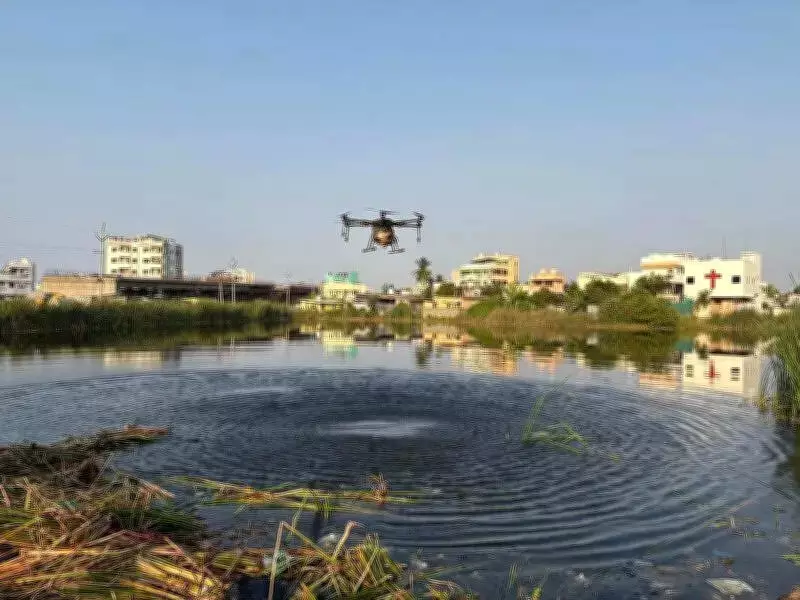
Guntur Municipal Corporation Deploys AI Drones in Intensive Anti-Mosquito Campaign
In a proactive response to escalating public complaints about severe mosquito infestations, the Guntur Municipal Corporation (GMC) has initiated a comprehensive and technologically advanced drive named "Mission Mosquito." This innovative campaign leverages artificial intelligence-enabled drones to systematically eliminate mosquito larvae throughout the city, marking a significant shift from traditional pest control methods.
Advanced Technology for Public Health Protection
Municipal Commissioner K Mayur Ashok addressed the media on Tuesday, emphasizing that the civic body has adopted cutting-edge technology to safeguard community health and effectively curb the transmission of dangerous vector-borne diseases. The cornerstone of this initiative involves deploying drones equipped with AI capabilities to precisely spray larvicidal chemicals over major water bodies and areas with stagnant water where mosquito breeding is most prevalent.
The large-scale operation encompasses 26 major ponds and low-lying regions with stagnant sewage, covering an extensive total area of 174 acres across Guntur. Commissioner Ashok explained that conventional approaches used in the past faced considerable limitations. Dense vegetation, including water hyacinth and thick aquatic growth, often made it hazardous and nearly impossible for malaria control staff to access water bodies for manual chemical spraying. Furthermore, the outcomes from these labor-intensive efforts were frequently inadequate and inconsistent.

Precision Targeting with AI-Enabled Drones
To overcome these persistent challenges, the GMC has introduced specialized AI-enabled drones that can fly at low altitudes over water surfaces. These drones are programmed to identify and precisely target mosquito breeding hotspots with remarkable accuracy. They are currently deploying Temephos larvicide directly onto areas where larvae develop, ensuring substantially higher efficiency and superior coverage compared to manual methods.
In addition to the drone operations focused on water bodies, the municipal corporation will continue its regular fogging activities and anti-larval measures across all city wards. Commissioner Ashok highlighted that utilizing drones dramatically reduces the time and manpower required for such extensive operations while enabling access to previously unreachable or hazardous zones. This technological integration significantly enhances the overall effectiveness and scope of the public health drive.
Call for Public Cooperation and Preventive Measures
However, the commissioner strongly emphasized that civic efforts alone cannot achieve complete success without active public participation. He urgently appealed to residents to take preventive actions by eliminating water stagnation in and around their homes. A key recommendation is observing a weekly "dry day" every Friday, during which citizens should thoroughly empty water from discarded items like old containers, tyres, and flower pots.
Such community-based preventive measures are absolutely crucial for protecting neighborhoods from seasonal outbreaks of diseases such as dengue, malaria, and chikungunya. The combination of advanced technological intervention and responsible public behavior creates a robust defense system against mosquito-borne health threats, setting a new standard for urban pest management and public health initiatives.






