

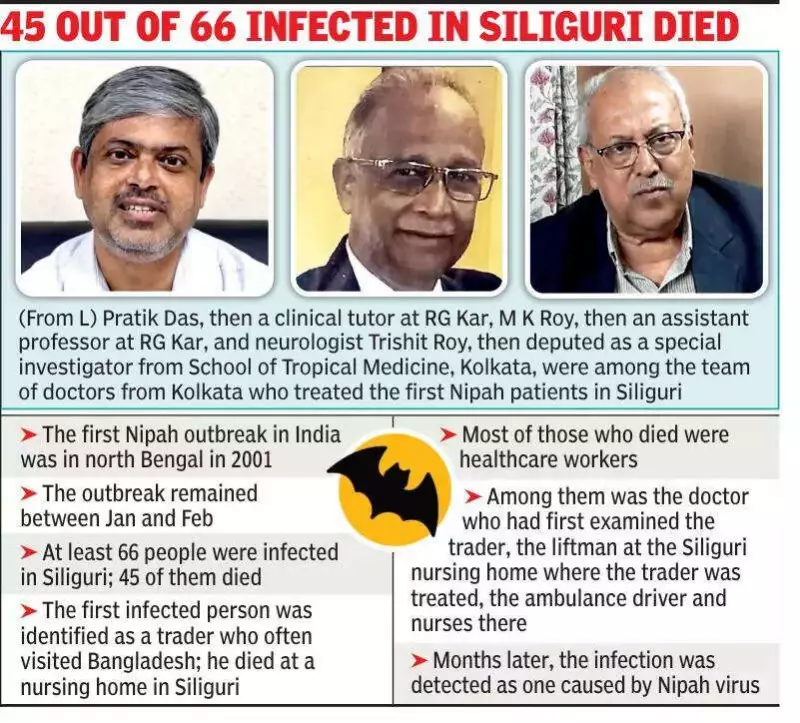
Kolkata Doctors Confront India's First Nipah Outbreak in 2001
In early 2001, a mysterious fever swept through Siliguri, West Bengal. Most people outside the medical community had never heard of the Nipah virus. This marked India's first recorded outbreak of this lethal infection. The situation quickly turned critical.
A Medical Team Rushes to Siliguri
A dedicated team of doctors from Kolkata responded to the crisis. They traveled with colleagues to fight the unknown disease. The government reserved a special compartment on the Uttar Banga Express for their journey. Nephrologist Pratik Das, then a clinical tutor at RG Kar Medical College, recalled the moment.
"I did not tell my parents as they would be scared. It was like the Army leaving for the battleground," said Das, now at RN Tagore International Institute of Cardiac Sciences. The team attended to patients at North Bengal Medical College and Hospital (NBMCH).

The Grim Reality of the Outbreak
Between January and February 2001, around 66 people contracted the infection. At least 45 of them died. The index patient, the first to show symptoms, died in a Siliguri nursing home. Authorities soon established isolation wards at NBMCH. They directed all symptomatic patients to this state facility.
Doctor M K Roy, an assistant professor at RG Kar then, described their preparations. "We carried 12 ventilators and medications with us. Of course, there was fear because of the unknown disease. But it was a call of duty for doctors. If we did not tend to patients, who would?" he said.
Healthcare Workers Bear the Brunt
Most deaths occurred among healthcare workers. This group included doctors, nurses, ambulance drivers, and even liftmen. One doctor who first examined the initial suspect at the nursing home also succumbed. Neurologist Trishit Roy, former director of Bangur Institute of Neurology, highlighted the severity.
"It was a disastrous outbreak with a high mortality rate. The situation was grim, we were groping in the dark as we did not know what was causing the infection. We tried our best to save the patients and contain the spread. The situation was far more serious than what the present outbreak is," he stated. Roy worked with virologist S Chakraborty from the School of Tropical Medicine, Kolkata, as special investigators.
Personal Sacrifices and Team Efforts
Gautam Mukherjee, then senior medical officer at RG Kar, shared his emotional departure. "My son, who was about to appear for his Class XII boards, broke down as I was leaving with 12 colleagues. With so many deaths around, with most being healthcare workers, our colleagues at NBMCH were demoralised. But it was our duty to step in," he recounted.
The medical team, led by then medicine HOD Apurba Ghosh, included doctors Bhaskar Bose and Nitai Das. The government provided all necessary protective gear. Thanks to these measures, none of the team members contracted the infection.
Collaboration and Containment
Later, teams from AIIMS Delhi and NIV Pune joined the efforts. They collected samples and coordinated with the state medical team. West Bengal continued sending various medical teams from Kolkata colleges until the outbreak finally subsided. Months after the initial cases, health officials identified the infection as caused by the Nipah virus.
This 2001 outbreak remains a stark reminder of the bravery and dedication of healthcare workers. They faced an invisible enemy with courage and professionalism, saving lives under extreme pressure.

