

Kolkata Hospital Lift Tragedy: Absent Operator Blamed for Fatal Malfunction
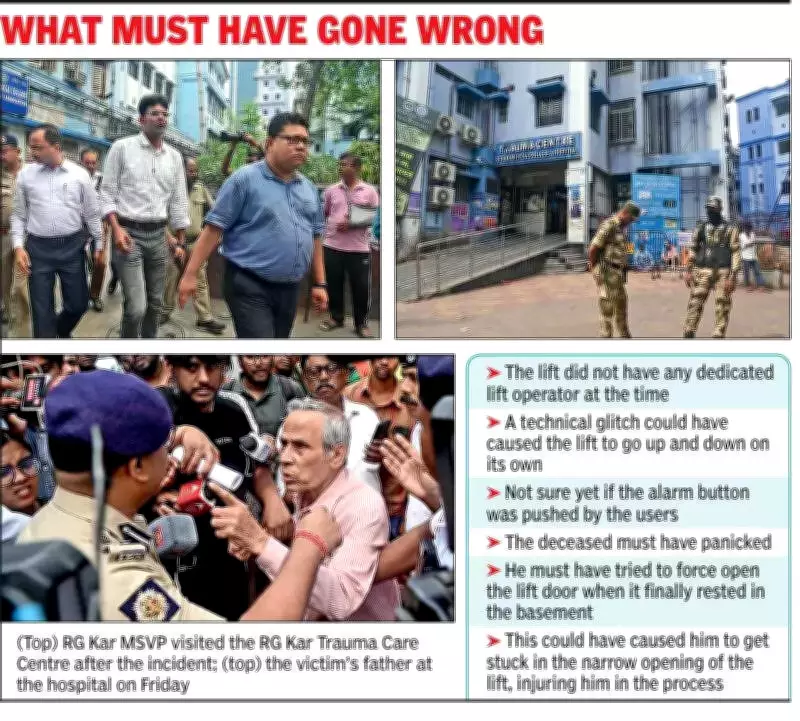
A tragic lift malfunction at RG Kar Medical College and Hospital in Kolkata resulted in the death of Arup Banerjee, who was trapped inside with his wife Sonali and son Ayush on Friday morning. The incident occurred in one of the hospital's trauma care building lifts, which notably lacked an operator at the time. Hospital sources have indicated that the presence of a lift operator might have averted this fatal accident, raising serious questions about safety protocols and maintenance standards.
Details of the Incident and Hospital Infrastructure
The seven-story trauma care building houses three lifts: one at the front reserved for doctors and staff, and two at the rear used by patients and hospital personnel. Arup Banerjee and his family entered one of the rear lifts. According to sources, the trauma building, which includes an emergency ward on the ground floor, experiences high foot traffic continuously, unlike other hospital buildings that see lower activity at night and early morning.
The family was attempting to access a pay-and-use toilet outside the building because their son, Ayush, was in pain from a hand injury and needed to use the washroom. "The boy was already in pain and trauma due to the hand injury. Since he was crying for the washroom, my nephew and his wife had to use the lift to go downstairs on their own," explained Arup's uncle, PK Banerjee. He emphasized that a lift operator would have known how to respond when the lift began malfunctioning.

Systemic Failures and Maintenance Issues
Doctor organizations, including the Association of Health Service Doctors (AHSD), have pointed out that lifts in the trauma building frequently suffer from mechanical faults. They attribute these problems to a lack of proper maintenance and safety audits. The hospital administration, however, stated that the Public Works Department (electrical) is responsible for lift maintenance, and they receive daily reports on lift conditions. Officials claimed the lift in question was functioning properly throughout Thursday, with no prior complaints of technical issues.
RG Kar Medical Superintendent and Vice President Saptarshi Chatterjee commented, "There was no complaint about any technical glitches in the lift where a person died. The entire technical team is investigating what must have gone wrong in the elevator's functioning." He added that while it is unclear if the alarm button was pressed, CCTV footage shows the victim's father raising an alarm after the family became stranded.
Manpower Shortages and Accountability Demands
Chatterjee revealed that the hospital has 32 elevators across various buildings and announced plans to ensure operators are present in each lift, along with posting cautionary signs advising patients and relatives to avoid using elevators without operators. However, sources highlight a significant manpower shortage, noting that while each lift should have an operator, this requirement is often unmet.
The AHSD has raised concerns about private agencies handling Operation and Maintenance (O&M) with impunity, citing a lack of supportive supervision from the health directorate to enforce contractual obligations. In a letter to the chief secretary, the association demanded accountability, a fair probe, and actionable measures to prevent future incidents.
This tragedy underscores critical gaps in hospital safety management, emphasizing the need for rigorous maintenance, adequate staffing, and enhanced oversight to protect patients and visitors in healthcare facilities.






