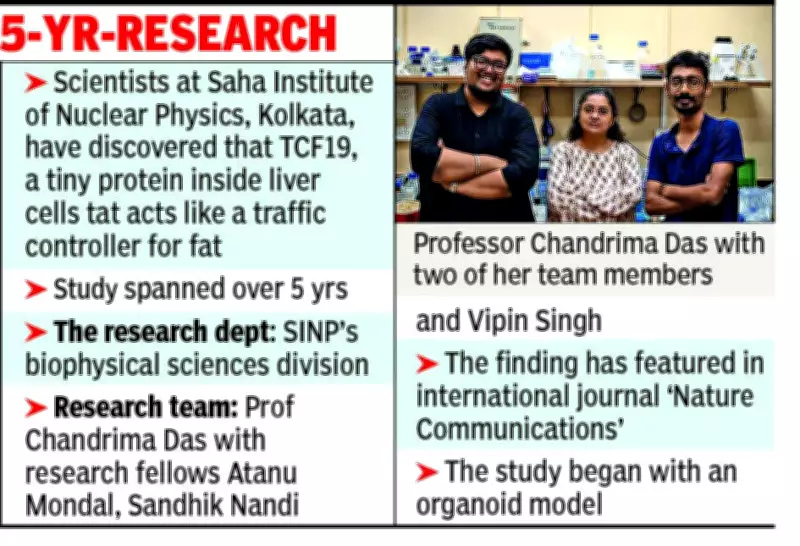
In a significant breakthrough published in the international journal Nature Communications, scientists from the Saha Institute of Nuclear Physics (SINP) in Kolkata have identified a tiny protein within liver cells that acts as a traffic controller for fat metabolism. This protein, named TCF19, plays a critical role in managing harmful fat accumulation in the liver, a condition that affects millions worldwide.
How TCF19 Protects the Liver
The research team, led by Professor Chandrima Das from the Biophysical Science Division at SINP, discovered that when the human liver is overwhelmed with toxic lipids—dangerous fats that can damage cells—TCF19 steps in to convert these harmful substances into triglycerides. Triglycerides are a safer, more stable form of fat that can be stored without causing immediate harm to liver cells. This conversion process buys the liver valuable time and slows the progression from fatty liver to more severe conditions like fibrosis, cirrhosis, or liver cancer.
Research Methodology and Findings
Over the past five years, a team of four researchers—including Atanu Mondal, Sandhik Nandi, and Vipin Singh—worked under Das to unravel this hidden molecular mechanism. The study focused on non-alcoholic fatty liver disease (NAFLD), a growing public health crisis affecting one in three adults globally. NAFLD is closely linked to obesity, type 2 diabetes, and cardiovascular disorders, and often goes undetected until it advances to severe liver damage.

The research began with organoid models, followed by experiments on 40 to 60 animals conducted at the Indian Institute of Science Education and Research (IISER) Pune. Clinical tests were also performed on 70 human participants with the assistance of medical doctors. The findings revealed that TCF19 acts as a gatekeeper, regulating the transition from fatty liver to fibrosis—a condition where the liver becomes stiff and increases the risk of liver failure or cancer.
Dual Role of the Protective Mechanism
Atanu Mondal, a senior research fellow at SINP, explained that the body's defense system can slow disease progression through this adaptive response. When the liver is exposed to toxic lipid stress, TCF19 helps convert harmful lipid species into triglycerides, a relatively safer storage form. While this mechanism protects the liver and delays progression to more severe stages, it also promotes fat accumulation within the liver, thereby marking the early phases of NAFLD.
Professor Das emphasized that the study suggests a more effective strategy for managing NAFLD may lie in fine-tuning how lipids are processed and balanced within liver cells. By shifting the focus from simple fat reduction to metabolic regulation, this research opens new avenues for targeted and nuanced interventions. As NAFLD continues to rise sharply among urban populations due to lifestyle changes such as high-fat diets and sedentary behavior, this work provides critical insights into liver disease prevention and treatment.