Acting on the Maharashtra government's directives, the Nagpur Municipal Corporation (NMC) conducted a massive survey that exposed glaring gaps in the city's stray dog management system. The government directives came after recent Supreme Court orders to safeguard public places from the growing stray dog menace.
Survey Findings
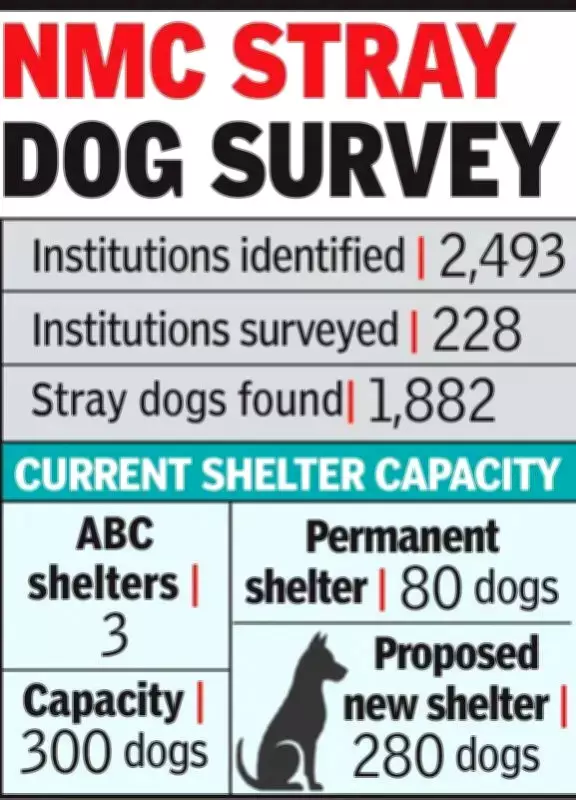
The NMC survey found 1,882 stray dogs roaming inside 228 public institutions across Nagpur, including the premises of the Nagpur Bench of the Bombay High Court. However, not a single animal was shifted to designated shelters due to inadequate holding capacity.
The findings, revealed in an official NMC report submitted to the state government, underline the severe shortage of shelters and infrastructure despite rising dog bite cases and repeated concerns over public safety. The Supreme Court had issued orders directing authorities to protect public places and sensitive institutions from the increasing stray dog menace. Following this, the Maharashtra government on November 24, 2025, instructed urban local bodies to conduct special inspections of schools, hospitals, transport hubs, and other crowded public places and remove stray dogs from such locations.

Institutional Inspections
According to the report, the NMC inspected 2,493 institutional locations across the city as part of the special survey drive. These included 1,714 educational institutions, 718 hospitals and health centres, 75 government offices, 22 playgrounds and sports complexes, and 14 transport hubs such as bus stands, depots, and railway stations. During the survey, civic teams found 1,882 stray dogs inside 228 institutions, raising serious questions over the effectiveness of existing control measures and the vulnerability of public spaces frequented by children, patients, commuters, and senior citizens.
Shelter Infrastructure Crisis
Despite the alarming number of dogs found roaming inside these premises, the report admitted that none of the animals could be relocated because the city lacks adequate shelter infrastructure. Nagpur currently has only three Animal Birth Control (ABC) shelters with a combined capacity of 300 dogs and one permanent shelter capable of housing merely 80 dogs. Together, these facilities can accommodate only a tiny fraction of the city's estimated stray dog population, which is believed to be close to one lakh.
The report acknowledges that the existing shelter infrastructure is incapable of handling the scale of relocation envisioned under the state government's directives. Instead of shifting stray dogs, authorities have largely focused on securing institutional premises by installing gates, fencing, and compound walls. According to the report, 1,190 institutions have already undertaken measures such as fencing, gate installation, or strengthening of compound walls to prevent stray dog entry.
Proposed Solutions
To address the crisis, the NMC has proposed construction of an additional shelter with capacity for 280 dogs. The proposed facility is expected to be completed by October 31, 2026. However, even the proposed expansion is unlikely to significantly bridge the massive gap between available shelter space and the rising stray population.
Sterilisation and Vaccination Efforts
The report also details the scale of sterilisation and anti-rabies vaccination drives carried out under the ABC programme. Between 2020 and 2025, the civic body sterilised 62,422 stray dogs and administered 82,731 anti-rabies vaccinations. Overall, till March 2026, more than 71,000 stray dogs had been sterilised under various drives. At present, the ABC programme is being operated through three NGOs employing 38 personnel, including veterinarians, paravets, and dog catchers. The civic body currently operates with 11 dog-catching vehicles, 113 cages, and a dedicated public helpline for stray dog complaints.
Public Outrage and Ongoing Crisis
The findings come amid growing public outrage over increasing dog bite incidents in Nagpur, with thousands of attacks reported in recent years despite repeated surveys, sterilisation campaigns, and multiple government directives. The report has now laid bare the widening gap between policy directives and the city's actual capacity to manage the stray dog crisis on the ground.