National Swap Transplantation Committee Constituted by NOTTO
The National Organ and Tissue Transplantation Authority (NOTTO) has officially announced the formation of a national swap transplantation expert committee. This 17-member panel is tasked with developing comprehensive National Swap Transplantation Guidelines, following directives from the Supreme Court of India.
IKDRC Representation and Committee Composition
Two distinguished nephrologists from the Institute of Kidney Diseases and Research Centre (IKDRC) in Ahmedabad have been appointed to this crucial committee. The team includes Dr. Vivek Kute, professor and unit head of nephrology, who also serves as treasurer of the Indian Society of Organ Transplantation (ISOT), and Dr. Divyesh Engineer, professor of nephrology.
The committee comprises 12 members from government institutions and five from private sector organizations, representing a balanced approach to addressing India's organ transplantation challenges.

Understanding Swap Transplantation
Dr. Vivek Kute explained the concept of swap transplantation in clear terms: "In general parlance, swap transplant can be understood as a procedure where the donor matching criteria for living organ donation might not be the best match for the intended recipient. In such cases, medical professionals use alternative criteria to identify optimal matches, facilitating transplants from donor A to patient B and vice versa."
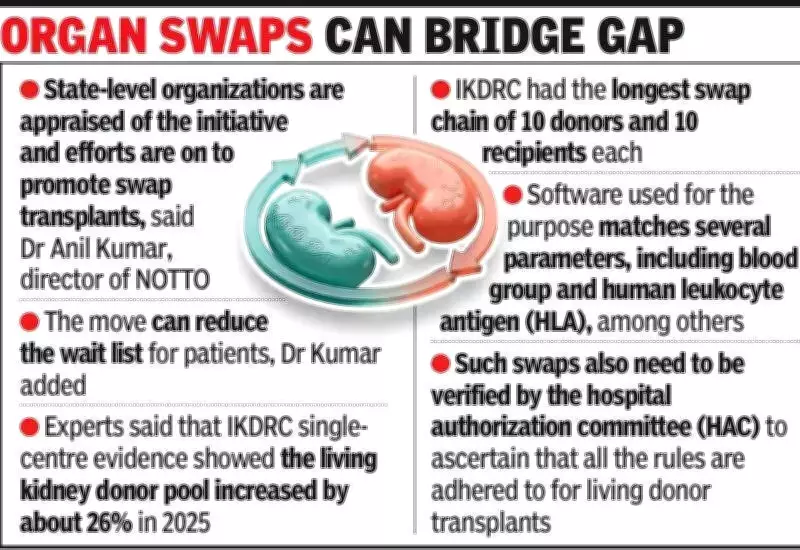
He highlighted IKDRC's remarkable success with this method, noting that 2025 witnessed the highest number of swap transplants at IKDRC, with 90 procedures out of 502 total transplants. Over 25 years, the center has performed 646 such procedures, establishing itself as a leading example of swap transplantation success in India.
Addressing Critical Waiting Lists
The implementation of structured swap transplantation guidelines could significantly impact India's organ waiting lists. Currently, Gujarat alone has 1,349 patients awaiting kidney transplants. While cadaver donations partially address this demand, living donor transplants remain the primary solution.
Dr. Kute emphasized that "this method can substantially reduce wait times for patients requiring organ transplants." Experts from ISOT project that properly implemented swap transplantation programs could lead to up to a 25% increase in transplant procedures nationwide.
National Registry and Technological Support
The committee's work is expected to establish a national registry dedicated specifically to swap transplants, modeled after successful systems in the United States and European nations. This registry would streamline matching processes and improve transparency across transplantation centers.
Dr. Manish Balwani, secretary of ISOT and member of the expert committee, revealed that ISOT has developed specialized software for donor-recipient matching, which has been provided to NOTTO free of charge to support this national initiative.
Committee Responsibilities and Objectives
According to the official NOTTO order, the expert committee has several critical responsibilities:
- Drafting and finalizing comprehensive national swap transplantation guidelines
- Developing training modules for swap transplant centers and coordinators
- Creating standardized proformas for reporting, monitoring, and auditing procedures
- Regularly reviewing and updating guidelines as medical practices evolve
This systematic approach aims to create a robust framework that will standardize swap transplantation practices across India, potentially saving thousands of lives through improved organ matching and allocation systems.