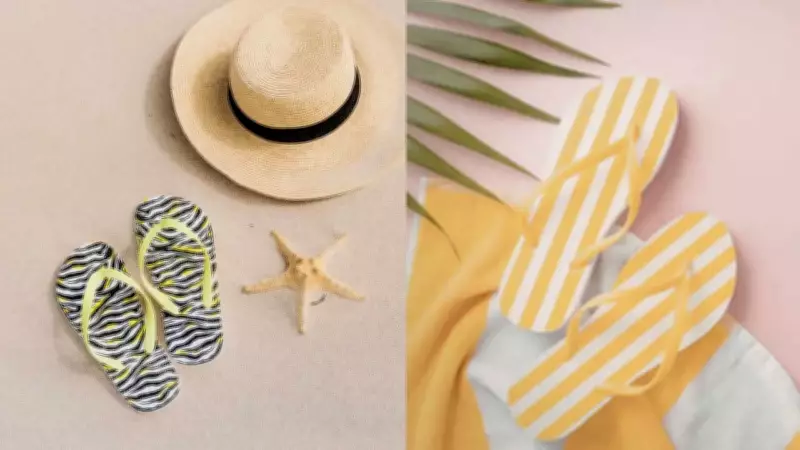
There is no denying that summer fashion often revolves around comfortable and effortless flip-flops. While many people purchase cheap, flimsy versions that have become the ultimate symbol of summer style, podiatrists warn that wearing them for anything beyond a quick trip to the beach can lead to serious, long-term damage to the feet, ankles, knees, and lower back. Here is everything you need to know.
The Hidden Dangers
Traditional rubber flip-flops lack fundamental structural integrity, offering zero arch support and negligible shock absorption. As your heel repeatedly strikes hard concrete with only a thin layer of foam for protection, the shock wave travels straight up your skeletal system, triggering localized heel pain and radiating joint fatigue.
Without a built-in arch, your foot is forced to overpronate, meaning it rolls excessively inward with every step. This unnatural collapse places immense, repetitive strain on the plantar fascia, the thick band of tissue running along the bottom of your foot, frequently resulting in the sharp, burning agony of plantar fasciitis.

The Toe-Gripping Change
Because flip-flops have no back strap and only a thin Y-shaped thong to hold them in place, your feet have to work overtime just to keep the shoes on. Your toes are forced to constantly scrunch and grip the footbed as you walk, a mechanical flaw that completely alters your natural stride. This chronic toe-gripping causes severe tendon imbalances over time. Podiatrists frequently treat flip-flop devotees for painful overuse injuries like Achilles tendonitis, shin splints, and permanent toe deformities such as hammertoes and bunions.
Podiatrist-Approved Alternatives
Fortunately, you do not have to give up open-toed footwear entirely; you just need to upgrade to options designed with foot biomechanics in mind:
- Recovery Sandals: Brands make recovery slides using thick, proprietary foam. These sandals absorb significantly more impact than standard shoes, cradling the foot and giving tired joints a chance to recuperate.
- Orthotic-Infused Sandals: Footwear companies design sandals with built-in, rigid arch support and deep heel cups. These features keep your foot properly aligned, distribute your weight evenly, and mimic the natural contour of the ground.
- Multi-Strap Utility Sandals: Brands often feature secure ankle and heel straps. By locking your foot into the footbed, these straps eliminate toe-gripping entirely, allowing you to walk with a normal, healthy gait.
How to Test
When shopping for summer footwear, podiatrists recommend performing the three-point check to see if a shoe is safe for your feet. First, try to bend the shoe completely in half; if it folds easily in the middle, reject it, as it should only flex gently at the ball of the foot. Second, try to twist the sole like a wet towel; a supportive shoe should resist twisting to prevent ankle rolling. Finally, look for a slight heel elevation rather than a perfectly flat sole, as a gentle lift takes the immediate strain off your calf muscles and Achilles tendons.
The Golden Rule
Podiatrists agree that you do not need to throw your flip-flops in the trash, but you must treat them like protective equipment rather than everyday footwear. Reserve thin, plastic flip-flops strictly for locker rooms, public showers, and pool decks. In these specific environments, flip-flops serve an excellent purpose: acting as a vital shield against nasty, highly contagious surface infections like plantar warts, athlete's foot, and fungal nail infections. Once you leave the pool or sand, swap them out for a supportive alternative.