

Nagpur Consumer Commission Upholds Ruling Against Doctors Over Misleading Diabetes Cure Claims
The State Consumer Disputes Redressal Commission's circuit bench in Nagpur has delivered a significant judgment, upholding findings that three Mumbai-based medical practitioners engaged in misleading advertising and deficiency in service by promoting ear acupuncture as a permanent cure for diabetes. This ruling reinforces consumer protection standards in the healthcare sector.
Background of the Case and Initial District Forum Order
The case originated from appeals filed by complainant Manohar Khorgade and doctors from the Dixit family, challenging an October 24, 2018 order from the additional district consumer disputes redressal forum. The district forum had previously directed the doctors to jointly pay Rs1 lakh as compensation to Khorgade, deposit Rs4 lakh in the Consumer Legal Aid Fund, publish corrective advertisements for three consecutive days, and pay Rs5,000 as litigation costs.
A bench comprising presiding member Kalyani Kapse and member Shaila Wandhare delivered a common order after examining cross appeals. The commission upheld the key findings regarding deficiency in service and misleading advertisement but modified the compensation aspect of the original order.

Modified Compensation and Commission's Rationale
The commission ruled that the Rs4 lakh originally designated for the Consumer Legal Aid Fund would instead be paid directly to the complainant, who is a senior citizen, within 30 days. This adjustment brings the total compensation amount to be paid to Khorgade to Rs5 lakh, significantly increasing his financial redress.
The commission observed that the advertisements relied upon by the complainant prominently claimed "Successful treatment of diabetes – no medicine, no insulin" and promised a permanent cure through ear acupuncture. While the doctors denied issuing these advertisements, the commission noted their failure to provide any convincing explanation regarding their publication.
"The contents of the advertisements are categorical, unqualified and capable of attracting any ordinary diabetic patient," the judges stated, describing the doctors' denial as unsupported by evidence.Complainant's Experience and Medical Evidence
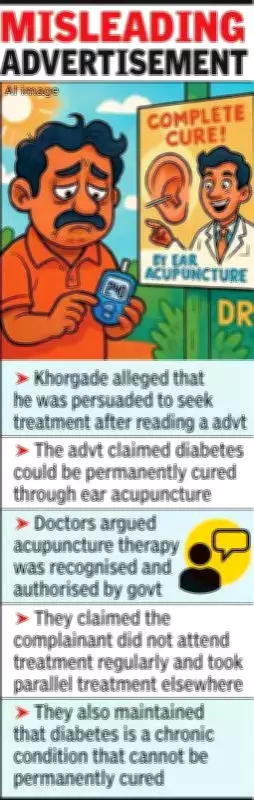
Khorgade, who has suffered from diabetes since 2010, alleged that he was persuaded to seek treatment after encountering a newspaper advertisement claiming diabetes could be permanently cured through ear acupuncture "without medicines or insulin." He began treatment on February 22 of that year and paid approximately Rs46,000 over time.
Despite following all instructions and undergoing regular blood sugar tests, Khorgade reported that his condition did not improve. Instead, his blood sugar levels increased, and he later developed complications affecting his eyesight and kidneys. Medical records presented before the commission confirmed that the complainant underwent prolonged treatment, but his blood sugar levels continued to rise.
The bench also noted a significant contradiction: when Khorgade's condition worsened, the doctors themselves issued an allopathic prescription, suggesting that their earlier claim of treatment without medicines or insulin had failed.
Doctors' Defense and Commission's Rejection
The doctors argued that acupuncture therapy is recognized and authorized by government authorities. They contended that the complainant did not attend treatment regularly and sought parallel treatment elsewhere. Additionally, they maintained that diabetes is a chronic condition that cannot be permanently cured.
However, the commission found no documentary evidence supporting these claims. The doctors failed to produce medical records showing irregular attendance or violation of treatment instructions. This lack of evidence weakened their defense and supported the commission's conclusion that their advertising was misleading and their service deficient.

Broader Implications for Medical Advertising and Consumer Protection
This ruling highlights critical issues in medical advertising ethics and consumer rights. By upholding the findings against the doctors, the commission sends a clear message about the responsibility of healthcare providers to avoid making unsubstantiated claims, particularly regarding chronic conditions like diabetes.
The case underscores the importance of transparency in medical treatments and the need for consumers to be cautious of advertisements promising miraculous cures. It also demonstrates the effectiveness of consumer redressal mechanisms in addressing grievances related to misleading practices in the healthcare industry.
As medical advancements continue, this judgment serves as a reminder to practitioners to adhere to ethical standards and provide accurate information to patients, ensuring trust and safety in healthcare services.





