NGT Takes Strong Action After Indore Water Contamination Tragedy
The National Green Tribunal's central bench in Bhopal expressed deep concern on Thursday. It reacted to fifteen diarrhea deaths linked to groundwater contamination in Indore's Bhagirathpura area. The tribunal stated that sewage mixing with drinking water created a severe public health and environmental crisis. This incident also highlighted similar systemic risks present in other urban centers.
A Gross Violation of Law and Rights
The Bhopal-based bench issued a strong statement. It said supplying contaminated water violates key laws. These include the Water Act of 1974 and the Environment Protection Act of 1986. It also breaches Article 21 of the Constitution, which guarantees the right to life. The bench linked this right directly to access to clean and safe drinking water.
In response, the tribunal issued detailed guidelines for the state government and all municipal authorities. A key proposal involves launching a 24x7 'Water App'. This application will help citizens lodge complaints about water quality directly.

Systemic Governance Failures Exposed
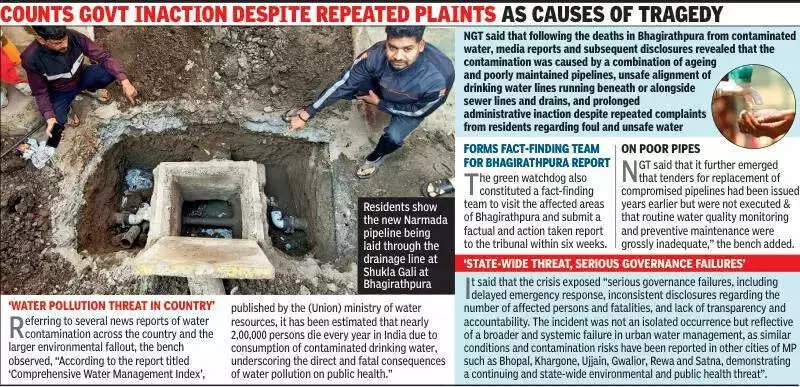
The NGT was blunt in its assessment. It said the Bhagirathpura crisis exposed serious governance failures. These included a delayed emergency response. Authorities also made inconsistent disclosures about the number of affected people and fatalities. The tribunal criticized a general lack of transparency and accountability.
"This was not an isolated event," the NGT emphasized. It described the situation as a symptom of a broader, systemic failure in urban water management. The bench pointed out that similar contamination risks exist in other Madhya Pradesh cities. It specifically named Bhopal, Khargone, Ujjain, Gwalior, Rewa, and Satna. This pattern demonstrates a continuing, statewide threat to public health and the environment.
The Root Cause of the Outbreak
The tragedy unfolded in the last week of December 2025. Residents of Bhagirathpura in Indore received severely contaminated drinking water through municipal pipelines. This led to a large-scale outbreak of water-borne diseases.
The consequences were devastating. Many affected residents required mass hospitalization. Several patients needed intensive care. The outbreak resulted in multiple fatalities, including infants and elderly people.
Laboratory tests confirmed the presence of dangerous pathogens. These included Vibrio cholerae, faecal coliform, and E. coli. The results clearly proved that sewage and polluted wastewater had infiltrated the potable water supply.
Investigations revealed the primary cause. A sewage tank was built directly over an underground drinking water pipeline in Bhagirathpura. This faulty infrastructure led directly to the contamination and the subsequent diarrheal outbreak.
Chronic Neglect and Inaction
The tribunal's order, delivered by judicial member Sheo Kumar Singh and expert member Ishwar Singh, detailed further neglect. The crisis resulted from a combination of factors:
- Ageing and poorly maintained pipelines.
- Unsafe alignment of drinking water lines running near sewer lines and drains.
- Prolonged administrative inaction despite repeated resident complaints about foul water.
It further emerged that tenders for replacing the compromised pipelines were issued years earlier. However, the work was never executed. Routine water quality monitoring and preventive maintenance were also grossly inadequate.
NGT's Directives and Future Safeguards
The green watchdog has taken concrete steps. It constituted a fact-finding team. This team will visit the affected areas of Bhagirathpura. They must submit a factual report and an action-taken report to the tribunal within six weeks.
The NGT warned that unsafe water infrastructure poses an imminent risk. Similar water-borne epidemics could easily recur without proper safeguards.
The tribunal's guidelines also include several broader mandates for urban water security:

- Removing encroachments around water bodies and groundwater sources in cities.
- Shifting dairies outside municipal limits.
- Banning idol immersion in water bodies like dams, ponds, wells, and stepwells (baoris).
- Making concerted efforts towards water harvesting during the rainy season.
The bench was hearing a batch of petitions filed by environment activists Rashid Noor Khan and Kamal Kumar Rathi. Their case brought this critical issue to the forefront, prompting the tribunal's decisive intervention.