

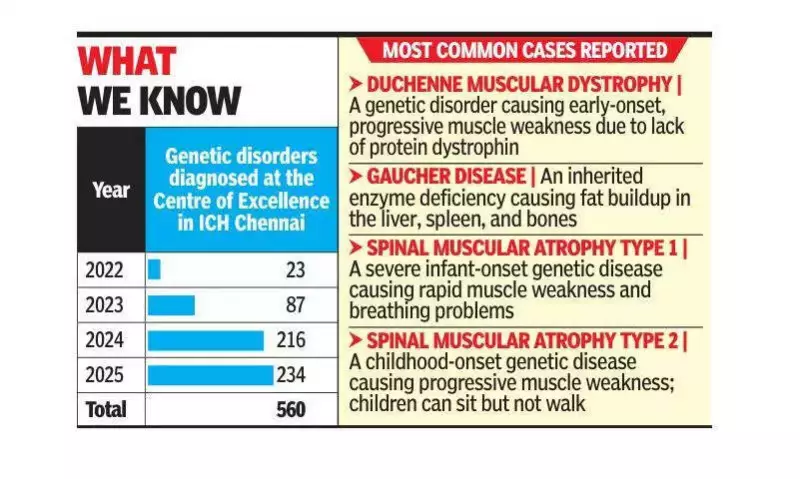
The Institute of Child Health (ICH) in Chennai has reported a significant and steady increase in cases of genetic disorders among children since it began tracking them in 2022. The numbers have risen sharply from 23 cases in 2022 to 87 in 2023, and then to 216 in 2024. So far in the current year, the institute has already recorded 234 cases, bringing the total count to 560.
Reasons Behind the Rising Numbers
Dr. M S Kalpana, who heads the centre, explained that the higher figures are likely due to two primary factors. First, ICH Chennai has become a major referral hub, receiving patients from across the country. Second, there is a marked increase in awareness among both physicians and parents.
"For example, if a child develops rashes in the first few months and a dermatologist rules out a common skin condition, parents are now referred to us to check for possible underlying genetic issues like eczema," Dr. Kalpana stated. This improved diagnostic pathway is bringing more cases to light.

Spectrum of Disorders and Treatment Approaches
Doctors at the institute note that more than three-quarters of the reported cases are neurological genetic conditions. These include severe disorders such as Duchenne muscular dystrophy, which leads to progressive muscle degeneration and primarily affects boys; Gaucher disease, characterized by the dangerous buildup of toxic substances in organs; and types II and III of spinal muscular atrophy (SMA), which cause muscle weakness due to the loss of motor neurons.
In the last six months alone, the centre also reported three new cases of the extremely rare Niemann-Pick disease. This is an inherited metabolic disorder where the body cannot properly break down fats, causing them to accumulate in cells, particularly damaging the liver and lungs.
Regarding treatment, Dr. Kalpana added, "Management typically involves specific drugs or enzyme replacement therapy, where functional enzymes are delivered directly into the bloodstream. If the disorder leads to other health complications or affects additional organs, we coordinate with other specialties to provide comprehensive care."
Diagnostic Advances and Funding Challenges
To bolster its diagnostic capabilities, the centre is equipped with advanced tools like tandem mass spectrometry to detect enzyme deficiencies. It is also in the process of installing next-generation sequencing equipment, which will help pinpoint precise genetic errors.
While government schemes provide substantial support—central funds cover treatment costs up to ₹50 lakh per patient, and the Chief Minister's Comprehensive Health Insurance Scheme covers testing up to ₹5 lakh—significant hurdles remain. The most daunting challenges are for families of children diagnosed with ultra-rare conditions that require cutting-edge, exorbitantly priced treatments like gene therapy, which is often only available overseas.
The emotional and financial strain on these families is immense. A mother from Nagapattinam shared her plight: "My 20-month-old was diagnosed with SMA type 1. The treatment costs around ₹8 crore, and we are considering crowdfunding to travel to the United States for it."
Future Plans: A New Institute for Enhanced Care
In response to the growing need for specialized care, the state health department has announced plans to establish a new institute of hemato-oncology by early next year. This facility aims to strengthen diagnosis, treatment, and cancer care for children.
Health Secretary P. Senthilkumar highlighted the expected benefits: "This will allow us to screen more patients, perform a greater number of bone marrow transplants, and create a robust platform for vital medical research." This move is seen as a critical step in addressing the complex healthcare needs of children with genetic and oncological disorders in Tamil Nadu and beyond.






