

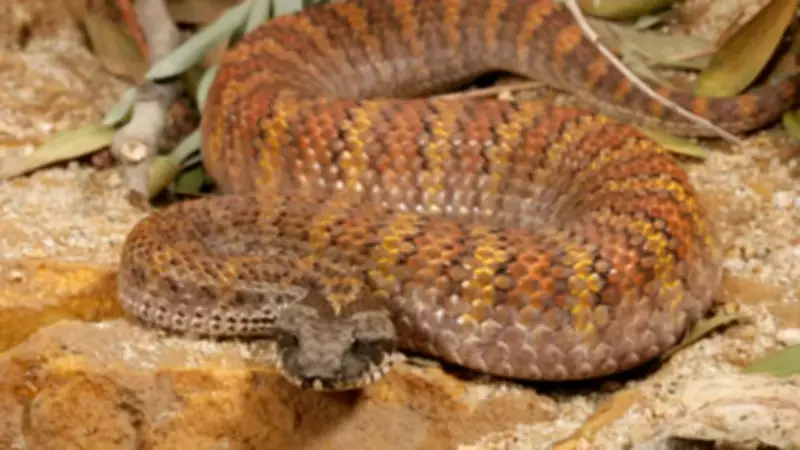
Death adders are among the most remarkable yet dangerous snakes native to Australia and parts of New Guinea. Despite their name, they are not true adders but share many similarities with vipers from other regions. This species demands attention for two main reasons: its highly toxic venom and its excellent camouflage, which even experienced trekkers can fail to detect. Learning to distinguish a death adder is crucial when traveling through forests, bushlands, and grasslands where it resides.
Distinctive Body Shape
A key feature of the death adder is its body type. While most snakes have long slender bodies, the death adder is short and thick, appearing triangular or oval when the head is lowered. Additionally, it has several spines on its tail. Coloration includes stripes and cross-bandings of brown, gray, reddish, or black. These dull, irregular patterns help the snake blend perfectly into forest floors, making it nearly invisible. Field guides for Australian fauna often note that spotting these snakes is accidental rather than deliberate.
Head and Tail Characteristics
The death adder's head is triangular and flat, resembling that of vipers but less sharply angled. Its tail is thin and pointed, ending in a worm-shaped appendage used as a lure. The snake wiggles its tail to mimic a worm or insect, attracting frogs and lizards into striking range.

Behavior
Unlike most hunting snakes that actively pursue prey, the death adder employs an ambush strategy. It can remain motionless for hours or even days. Stillness is a hallmark; when a stick or leaf pile moves and reveals a snake, it is likely a death adder. When threatened, it does not flee but stays put and may strike rapidly. Its strike speed is among the fastest of any snake species.
Habitat
Death adders primarily inhabit dry forests, woodlands, grasslands with leaf litter, coastal heath regions, and sandy or rocky areas with ample cover for camouflage. They favor locations that allow surprise attacks. According to studies by the Australian Museum, they are most active during twilight hours (morning and evening).
Scientific Insights
Research by Australian herpetologists, documented in CSIRO reports, shows that death adders rely on camouflage and hiding rather than movement. Their hunting technique consumes less energy but has high success rates compared to other venomous snakes. National Geographic Society media has described them as "masters of disguise" because their survival depends on going undetected. These studies highlight that you are more likely to stand near a death adder than to see it move.
Identification Errors
Death adders are often confused with harmless snakes like small pythons and baby brown snakes. Key differences include: death adders are smaller and thicker, remain still for long periods, have wider triangular heads, and possess a lure-like tail tip. A common mistake is assuming all thick-bodied snakes are pythons, but death adders belong to the elapid family, not constrictors.
Safety Precautions
The cardinal rule when identifying a death adder is not to rely on your ability to see it from a safe distance. Even experienced individuals may overlook these camouflage experts. In their habitat, wear appropriate footwear, use a walking stick to stir the ground ahead, and watch your step. Death adders are a remarkable product of natural selection, featuring perfect camouflage, rapid strikes, and patient hunting. However, these traits make them extremely dangerous in accidental encounters. Identifying a death adder is largely about interpreting stillness rather than motion.






