

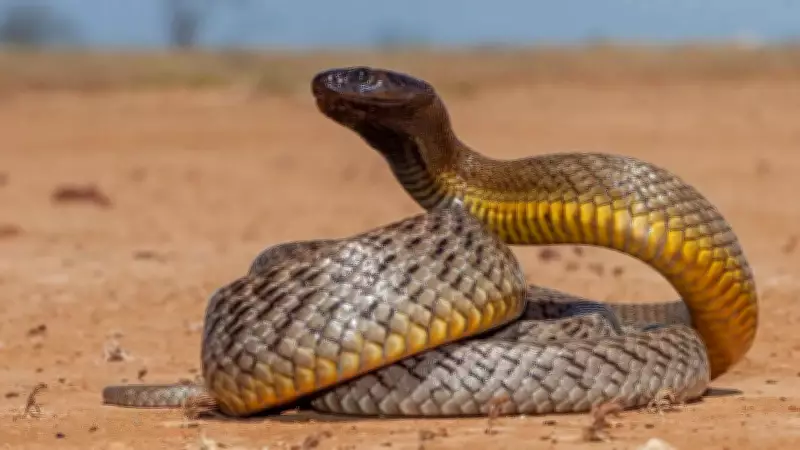
Inland Taipan: An Overview
The Inland Taipan, commonly referred to as the "fierce snake," is a highly venomous snake species endemic to Australia. It possesses an elongated and slender body that can reach up to approximately two meters in length. Its elegant structure includes a small head that is barely noticeable in proportion to the rest of its body. This snake exhibits notable seasonal variation in coloration. During winter, its head and dorsal surfaces darken to a deep brown, often appearing nearly black. In contrast, during summer, its body transforms to an olive or tan hue. The ventral side is pale, displaying a cream or yellow tone, sometimes accented with brown or orange patches. The scales are tiny and shiny, contributing to its sleek appearance.
Head Characteristics and Markings
The head of the Inland Taipan is long but narrow, distinguishing it from many other venomous snakes. Its eyes are relatively small, and it lacks prominent stripes or patterns on its head. The absence of distinctive head markings often makes it challenging to differentiate from similar brown snakes found in the same region.
Behavior and Temperament
Contrary to popular belief, the Inland Taipan is highly shy and elusive. It rarely comes into contact with humans and actively avoids conflicts. When encountered, it prefers to flee rather than engage in confrontation. This reclusive nature contributes to its reputation as a misunderstood species.

Habitat and Geographical Information
An essential aspect of recognizing the Inland Taipan is its habitat. This snake is endemic to the arid regions of Australia, particularly areas characterized by cracking clay soils and low vegetation cover. It commonly resides in deep soil cracks or abandoned animal burrows. Its geographical distribution is strictly limited to Australia; any sighting of a similar snake in other countries is unlikely to be the Inland Taipan.
Scientific Research and Findings
Scientific studies, including publications in journals such as Toxicon, have revealed that the Inland Taipan's venom is highly potent, containing neurotoxins and factors that impair coagulation. The toxins act rapidly, inducing paralysis and exerting a strong effect on prey. Recent research has identified symptoms of envenomation, including coagulopathy and neuromuscular paralysis. Additionally, studies indicate that the venom has evolved to efficiently paralyze fast-moving prey, such as rats.
According to a study by Billa Bong Sanctuary, the most reliable method for identifying most snakes involves counting the rows of scales across the back at mid-body and examining scale patterns on the head and tail. While some species have distinctly recognizable body shapes and unique scale arrangements, color alone is generally not a dependable feature due to significant variation. To accurately identify the Inland Taipan, one must consider its slender body shape, small smooth scales, season-specific coloring, slim head, lack of head patterns, and strictly limited Australian range. Nonetheless, due to its resemblance to other brown snakes, precise identification may require specialized skills.
About the Author
The TOI Lifestyle Desk is a dynamic team of dedicated journalists who, with unwavering passion and commitment, sift through the pulse of the nation to curate a vibrant tapestry of lifestyle news for The Times of India readers. At the TOI Lifestyle Desk, we go beyond the obvious, delving into the extraordinary. Consider us your lifestyle companion, providing a daily dose of inspiration and information. Whether you're seeking the latest fashion trends, travel escapades, culinary delights, or wellness tips, the TOI Lifestyle Desk is your one-stop destination for an enriching lifestyle experience.

