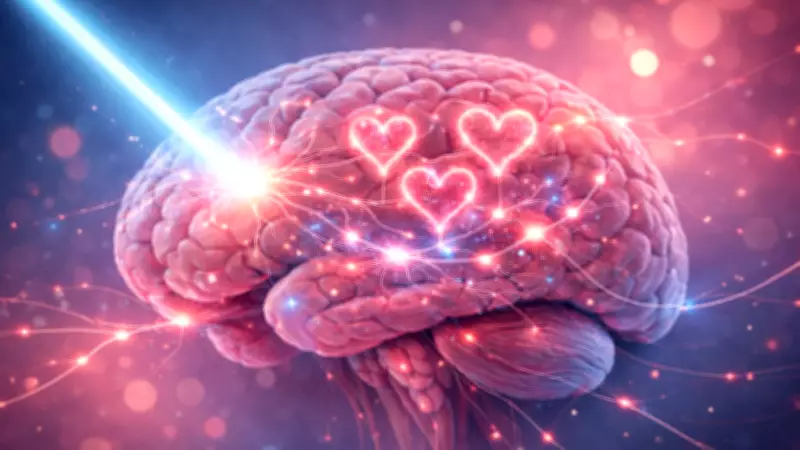
Scientists Develop Revolutionary 'Light Switch' for Brain's Love Hormone
In a groundbreaking development that could transform our understanding of human emotions and social behavior, researchers have created a powerful new technique that functions like a precise "light switch" for oxytocin—the neurochemical often called the brain's love hormone. This innovative approach, pioneered by scientists at the University of Queensland, enables unprecedented control over oxytocin activation in specific brain regions using targeted light exposure.
Unprecedented Precision in Neuroscience Research
The revolutionary method allows researchers to release oxytocin with extraordinary accuracy in particular brain areas, making it possible to observe in real time how individual neurons and neural circuits respond to this crucial hormone. For decades, neuroscientists have struggled to isolate oxytocin's exact effects within the brain's complex architecture, but this new technique finally provides the tools to pinpoint how emotions, social bonding, and behavioral patterns form at the fundamental cellular level.
The "light switch" mechanism operates through an advanced chemical process known as photocaging. In simple terms, scientists attach a light-sensitive chemical group to oxytocin molecules, effectively keeping them inactive or "locked" within the brain. This means the hormone remains present but cannot interact with cells until researchers shine a laser at a specific wavelength, which instantly removes the chemical cage and releases active oxytocin exactly where and when needed.

Solving Longstanding Research Challenges
This level of precision represents a monumental breakthrough because the brain functions through highly localized signaling pathways. A subtle change in one specific circuit can produce dramatically different effects compared to broader, uncontrolled chemical release. Until now, scientists understood that oxytocin played crucial roles in emotional regulation, social bonding, and behavioral patterns, but they couldn't determine which specific brain circuits were responsible or how these effects unfolded in real time.
The new light-controlled system solves this fundamental problem by allowing researchers to activate oxytocin at precise locations and moments, enabling observation of how individual neurons respond and how emotional signals form throughout neural networks. This capability could help explain fundamental human experiences including trust development, emotional attachment, and relationship formation.
The Critical Importance of Oxytocin
Oxytocin stands as one of the most significant neurochemicals involved in human social behavior. It plays a central role in how people form emotional connections across various relationships—from romantic partnerships and friendships to parent-child bonding. The hormone also influences trust development, empathy, learning processes, and memory formation.
Oxytocin works in close coordination with vasopressin, another neuropeptide that affects social behavior including attachment patterns and, in certain contexts, aggression responses. Together, these chemicals help shape how individuals navigate social situations and build relationships over extended periods.
Transforming Mental Health Research
The implications for mental health research are particularly significant. Disruptions in oxytocin signaling have been linked to numerous conditions including autism spectrum disorders, depression, anxiety disorders, post-traumatic stress disorder, and schizophrenia. However, until now, researchers have struggled to determine exactly how and where these disruptions occur within the brain's complex circuitry.
With this new precision tool, scientists could identify the exact neural pathways involved in various mental health conditions. This discovery could eventually lead to more targeted therapies that focus specifically on affected brain regions rather than altering the brain's overall chemistry, potentially reducing side effects and improving treatment effectiveness.

A Broader Scientific Breakthrough
Although the current research focuses primarily on oxytocin and vasopressin, the underlying technique has far-reaching applications across neuroscience. The same approach can be adapted to study other neuropeptides and signaling molecules within the brain, particularly in research areas where genetic tools prove difficult to implement.
The study, published in Angewandte Chemie International Edition under the leadership of Markus Muttenthaler, represents part of a broader scientific effort to develop precision tools for neuroscience research. By providing a non-genetic method of chemical control, this technique expands the range of experiments scientists can perform across various biological systems.
Future Implications and Applications
While the concept of a "light switch" for emotional chemicals might sound like science fiction, the reality represents a significant advancement in fundamental neuroscience. This technology isn't about directly controlling emotions but rather understanding how they function at their most basic biological level.
By revealing how oxytocin shapes human connection at the level of individual neurons, this research brings scientists closer to decoding one of humanity's most complex aspects—our capacity for emotional experience and social interaction. In the long term, this knowledge could reshape approaches to mental health treatment, relationship understanding, and the biological foundations of social behavior.
The breakthrough represents an important step toward understanding what fundamentally makes us human, offering clearer insights into how we form bonds, experience emotions, and interact within our social worlds.