

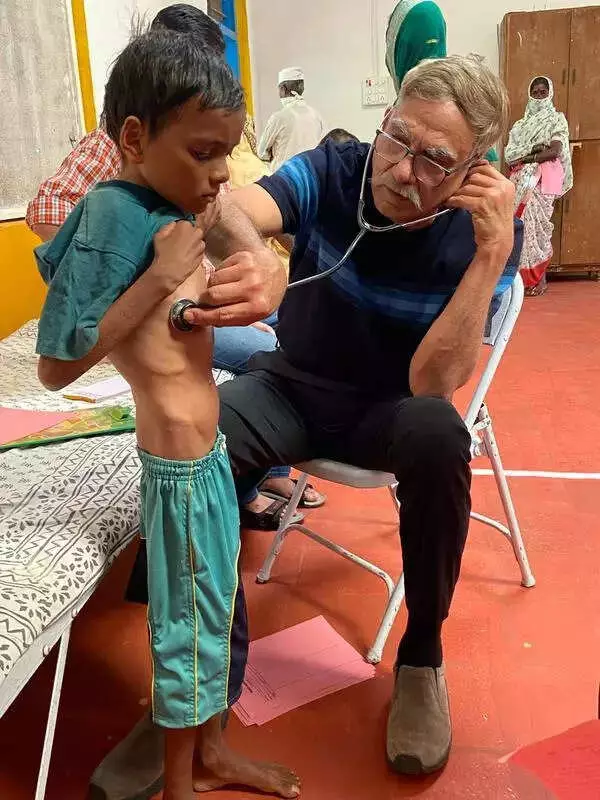
For more than three decades, a senior surgeon has served as the primary healthcare provider for impoverished and tribal populations in Maharashtra's Palghar and Thane districts. Dr. Vishwas Sapatnekar, now 78 years old, continues his mission of delivering medical care to those with little or no access to basic health services.
A Life of Service Beyond Retirement
While many his age enjoy a retired life, Dr. Sapatnekar wears multiple hats with quiet dedication. He is not only a skilled surgeon but also a humanitarian, a trained scuba diver, a teacher, and a relentless volunteer. An alumnus of the prestigious Armed Forces Medical College, he began his medical practice in London after completing his education. However, he returned to India in 1982 with a clear purpose, establishing a hospital in Thane that became the base for his lifelong commitment to the underprivileged.
From Thane Creek to Conflict Zones: A Diverse Legacy
Dr. Sapatnekar's courage extends beyond the operating theatre. In 1993, his expertise as a highly trained scuba diver proved vital for national security. He assisted agencies in a high-risk operation to retrieve RDX explosives that terrorists had dumped in the Thane creek. "I ran a scuba diving centre and was experienced. I volunteered," he recalled. That single step encouraged other divers to join, leading to the extraction of a large quantity of RDX.

His humanitarian spirit has also been a familiar sight for four decades during the annual Pandharpur wari pilgrimage. He and his medical team provide crucial aid to thousands of warkaris who undertake the arduous journey on foot. "Treating warkaris is the most satisfying service of my life. It feels no less than serving Lord Vitthal," he expressed.
Building Trust in Tribal Heartlands
Perhaps his most enduring legacy is his work among the tribal communities of Thane and Palghar. The early years were fraught with immense challenges. "Forty years ago, there were no roads, electricity, or basic services. Tribals were hesitant to take medicines. We had to create awareness and win their confidence," he said. Medical care was delivered in the most rudimentary conditions. "We used to sit on rocks and treat patients. Sometimes saline bottles were hung from trees under the open sky in Devband village of Palghar."
Today, that same village has a small clinic, and patients needing specialised care are referred to his Thane hospital. "What mattered most was that we reached out when no one else was ready. Sustaining that service for over three decades was the biggest and most rewarding challenge," Dr. Sapatnekar noted.
His commitment to serving in difficult conditions took him to conflict-ridden South Sudan twice during 2014–2016 as part of Doctors Without Borders. There, he treated some of the world's poorest patients amid violence. He even faced a dangerous situation where his vehicle was stopped by a rebel group demanding ransom. After explaining his mission to serve the poor, he was allowed to proceed.
Now, Dr. Sapatnekar regularly addresses medical students, urging them to look beyond lucrative urban practice and acknowledge their responsibility towards marginalised communities. "Medicine is not just about surgery or diagnosis for me. It is about standing by people when they are at their most vulnerable," he affirms. Through quiet, consistent, and compassionate work, Dr. Vishwas Sapatnekar continues to be a true lifeline for thousands.






