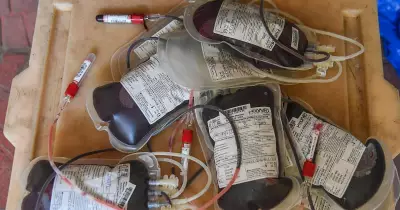
A serious case of medical negligence at a government-run hospital in Rajasthan has ignited demands for justice and exposed glaring gaps in patient safety protocols. The family of a 75-year-old woman is fighting for accountability after she was administered a blood transfusion of the wrong type, a mistake that put her life in immediate danger.
A Life-Threatening Error on December 17
The incident occurred on December 17 at the PBM Hospital in Bikaner. Bhawari Devi, 75, who was admitted for treatment and has blood type A positive, mistakenly received a transfusion of B positive blood. Her grandson, Govind Kumar, who was present during the procedure, recounted the terrifying ordeal to the Times of India.
"I saw my grandmother quickly deteriorate. She felt unconscious and had trouble breathing. It was a scene that no family should have to witness in a hospital," Kumar said, highlighting the direct consequence of the error. He attributed the fatal mix-up to confusion arising from another patient having a similar name, a basic failure in patient identification protocols.

Mere Transfers, Not Accountability
The family's distress turned to outrage upon learning about the hospital's response. Following an internal investigation, the supervising SP Medical College merely reassigned the positions of two resident doctors, two nurses, and a lab technician found responsible for the error. This action has been widely criticized as a grossly inadequate response to a mistake that could have been fatal.
Ved Vyas, a family friend and Bikaner district BJP office-bearer, condemned the hospital's action. "Transferring staff is not a punishment; it is a slap on the wrist," Vyas stated. "What message does this send about accountability in our healthcare system? The safety of patients is at stake, and yet the hospital's management seems more concerned with covering up than addressing this serious negligence."
Calls for Stricter Action and Systemic Change
The family, along with critics, is demanding stringent disciplinary action against those responsible. They emphasize that timely intervention prevented a tragedy, but the lack of serious repercussions sets a dangerous precedent. This incident raises profound questions about patient safety and accountability within government healthcare facilities.
The case of Bhawari Devi underscores an urgent need for robust systems to prevent such errors. Health authorities are now being urged to treat this incident with the gravity it deserves to ensure such a life-threatening lapse is never repeated. The family's pursuit of justice continues, hoping it will lead to meaningful reform and stricter oversight in hospital procedures.