

The Chhattisgarh government has launched the 14th phase of its flagship 'Malaria Mukt Chhattisgarh Abhiyan' to consolidate gains against malaria in vulnerable regions. Health teams are set to screen more than 16.2 lakh people across Bastar division and other high-risk districts.
Campaign Scope and Coverage
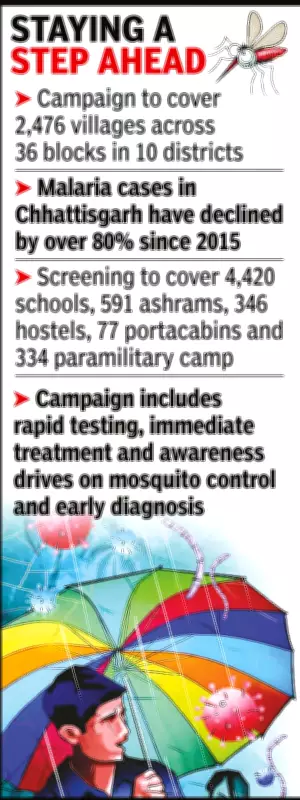
The campaign, which began on June 15, will cover 2,476 villages across 36 development blocks in 10 districts. This includes all seven districts of Bastar division — Bastar, Dantewada, Sukma, Bijapur, Narayanpur, Kanker and Kondagaon — along with Gariyaband, Kabirdham and Khairagarh-Chhuikhadan-Gandai.
A total of 2,063 survey teams have been deployed to conduct door-to-door visits, identify fever cases, carry out rapid malaria testing and ensure immediate treatment of those found infected. The Bastar region was once regarded as one of the country's worst malaria hotspots.

Progress and Impact
According to health department data, Bastar division's annual parasite incidence (API) — a key indicator used to measure malaria burden — has fallen from 27.40 in 2015 to 6.98 in 2025. Statewide, the API dropped from 5.21 to 0.90 during the same period.
Officials said overall malaria cases in Chhattisgarh have declined by more than 80% between 2015 and 2025, a reduction they attribute to repeated mass screening campaigns, active case detection and timely treatment in remote tribal areas. The results of the previous phase, conducted in January this year, were also encouraging. Health authorities reported that malaria positivity rates fell from 4.60% to 0.48%, indicating improved surveillance and early detection mechanisms.
Focus on Remote Areas
Health officials said the campaign's focus remains on reaching remote and forested habitations where access to healthcare services is often limited and malaria transmission tends to intensify during the monsoon season.
Special emphasis is also being placed on institutions housing children and adolescents. Dedicated teams have been assigned to cover 4,420 schools, 591 ashrams, 346 hostels, 77 portacabin schools and 334 paramilitary camps during the campaign.
Awareness and Prevention
Apart from testing, survey teams will conduct awareness drives on mosquito control, use of preventive measures and the importance of seeking treatment at the onset of symptoms such as fever, chills, headache and weakness.
With monsoon conditions setting in across much of the state, health officials said community participation would remain crucial in sustaining the gains made against the disease.
"Malaria can be effectively controlled through early diagnosis and timely treatment. People are being encouraged to cooperate with survey teams and undergo testing if they show symptoms," a health department official said.






