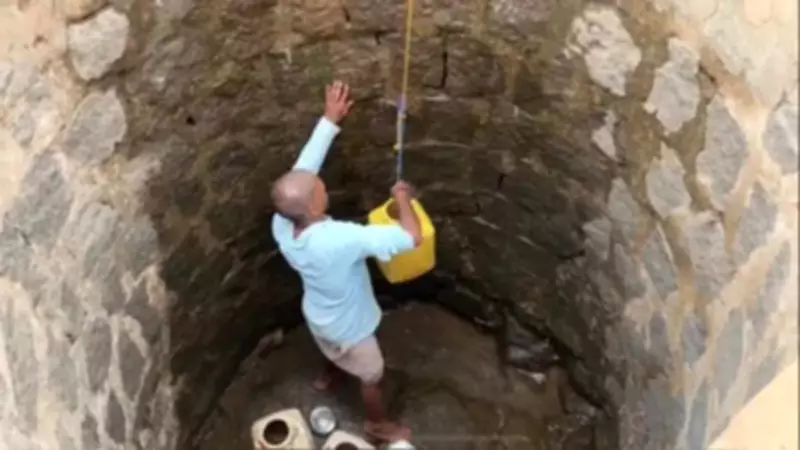
Every day, Mahipal Singh descends into a deep, nearly dry well in a remote corner of Chhattisgarh's Manendragarh-Chirmiri-Bharatpur (MCB) district, balancing on its slippery inner walls to reach a small pool of water at the bottom. There, he fills buckets and plastic containers for fellow villagers waiting above — a daily ritual that has become essential for survival in Navapara, a hamlet of around 300 residents grappling with an acute drinking water crisis.
Water Crisis in Navapara Village
The crisis has unfolded in Navapara village under Lohari gram panchayat, where residents are struggling to secure enough water for daily use amid falling groundwater levels and the failure of local water supply systems. Several videos from the remote village show Mahipal Singh descending deep into the well, which has little water left. He performs this as a duty to fill buckets and plastic containers for villagers every day.
"We have to bear with it. The water is dirty, there's a risk of injuries, but what else can we do? We manage with whatever little we have," Singh said.

Temporary Relief and Infrastructure Issues
Sarpanch Moti Singh explained, "For the past one week, I have arranged for tankers in the village for temporary relief. The tanks installed under Jal Jeevan Yojana are leaking, and I have informed officials about it and the poor condition of pipelines too." He also pointed to geological challenges, noting that Navapara is located in a hilly region where groundwater is often found only at depths of 500-600 feet, while several borewells drilled in the area have failed.
Villagers say the water level in the area's only functional well has dropped so sharply that people are forced to descend several metres into the structure to fill buckets and containers, often risking injury. Long queues begin before dawn and continue late into the night as families wait their turn.
"Fetching water has become the biggest part of our daily routine. There's no water anywhere," said Ghuran Singh, claiming some villagers remain in line until midnight while others return before sunrise in the hope of finding water.
Impact on Residents
Another resident, Jagmat Bai, said water is the biggest problem. "There are water tanks installed only to show off, which have no water. One tanker comes sometimes; how would it suffice a village? The taps are installed everywhere under projects, but there is no water," she fumed. Residents allege that the water available in the well is often muddy and contaminated with silt, forcing them to filter it before consumption. The water shortage has hit women, children, and elderly residents particularly hard, with many spending hours every day collecting water instead of attending to work, school, or household responsibilities.
Government Response
Villagers alleged that despite significant expenditure under government drinking water schemes, the promised benefits have not reached them. Responding to the reports, MCB collector Santan Devi Jangde told reporters that the matter had come to her notice and assured that officials would verify the situation on priority. She said alternative arrangements would be made if a severe water scarcity situation exists in the affected hamlet. The collector also said complaints regarding leakages in the Jal Jeevan Mission tank would be investigated and action taken if any negligence is found.