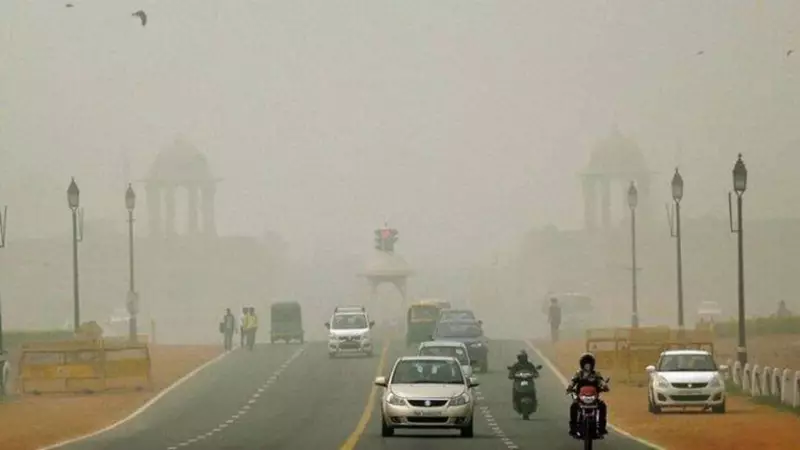
The air quality in the National Capital Region (NCR) deteriorated sharply on Saturday, December 28, 2025, with several cities hovering at the brink of or entering the severe category. The situation has reignited health concerns among residents as meteorological conditions remain unfavorable for dispersion.
NCR Cities Dominate National Pollution Chart
According to data released by the Central Pollution Control Board (CPCB), the most polluted cities in the country on Saturday were all clustered within the NCR. Noida recorded the worst air, with its AQI slipping into the 'Severe' category at 409, a significant jump from 376 on Friday. It was closely followed by Ghaziabad at 404 and Greater Noida at 395.
Delhi itself was not far behind. The capital's average Air Quality Index rose from 333 on Friday to 385, placing it perilously close to the 'Severe' threshold and ranking it as the fourth most polluted city in the country. In a slight contrast, Gurgaon witnessed marginal improvement, with its AQI easing from 312 to 299.
Sources of Pollution and Unfavorable Weather
Analysis from the Indian Institute of Tropical Meteorology (IITM) Pune's Decision Support System pinpointed the major contributors to Delhi's dangerous PM2.5 concentrations. Transport emissions remained the top source, accounting for 16.22% of the pollution load. Industrial emissions contributed 8.4%, while residential sources, waste burning, construction, and road dust together added approximately 9%.
The report also highlighted significant external contributions from neighboring regions. Jhajjar was the highest external contributor at 17.59%, followed by Sonipat at 5.8% and Rohtak at 4.6%.
The weather outlook offers little hope for immediate relief. The India Meteorological Department (IMD) recorded a maximum temperature of 22.2°C, 1.8 degrees above normal, and a minimum of 7.8°C. It has forecast moderate to dense fog on Sunday morning. Critically, the IITM has projected that Delhi's air quality will likely remain in the 'Very Poor' category through December 30, with a similar forecast for the subsequent six days.
Why Pollutants Are Not Dispersing
Key atmospheric indicators explain why the toxic haze is persisting over the region. The IITM forecasts that the maximum mixing height—the vertical limit for pollutant dispersion—will reduce to about 700 metres from the current 850 metres by December 30. Simultaneously, the ventilation index, a crucial measure of the atmosphere's ability to disperse pollutants, is expected to remain below 6,000 m²/s, fluctuating between 3,000 and 5,000 m²/s.
These conditions, combined with average wind speeds staying below 10 kmph, create an environment highly unfavorable for the clearing of pollutants. The lack of strong, sustained winds, which had provided brief respite earlier in the week, means residents must brace for continued poor air quality in the final days of the year.