

Hepatitis Outbreak in Palwal Village: 32 Cases Confirmed Amid Water Contamination Fears
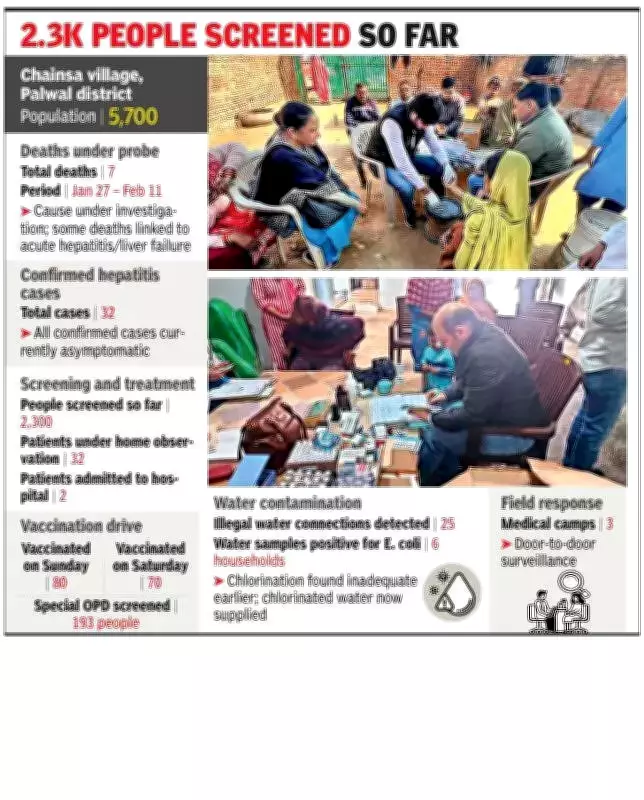
In a concerning development, three fresh hepatitis infections have been reported in Chhainsa village of Palwal, pushing the total number of confirmed cases to 32. These new cases mark the first instances of Hepatitis B recorded in the village in recent weeks, adding to the existing Hepatitis C infections that have been detected.
Health Screening and Treatment Efforts
Officials stated that the three new cases were identified during random screenings, which were initiated following seven deaths reported over the past 15 days. Of the 32 confirmed cases, three are Hepatitis B, while the remaining are Hepatitis C. A senior doctor involved in the health exercise emphasized, "As of now, none of the patients has symptoms. We are prescribing medicines for them and immunising everyone against Hepatitis B and C."
Health teams have screened more than 800 residents and collected blood samples for viral load testing, which will determine the course and duration of treatment. The doctor explained, "Treatment depends on the viral load. If the viral load is low, there is no need for long-term medication. As a precaution, medicines are being given for now. After 10-15 days, those with high viral load will continue treatment, while medicines will be stopped for others."

Investigation into Deaths and Water Contamination
While the deaths have heightened anxiety in the village, officials noted that investigations are still underway to establish whether the fatalities were directly caused by hepatitis. In the wake of the infections, many villagers have complained about symptoms such as fever, vomiting, body pain, and cough.
Currently, two patients are admitted to the civil hospital, while the rest are being monitored at home. Officials reported that those admitted earlier as a precaution have stabilised.
The investigation has also turned the spotlight on possible water contamination. During inspections, the public health department discovered 25 illegal connections to drinking water pipelines, which led to leakages and raised fears of contamination. Officials confirmed that these connections have now been removed, and engineers are checking supply lines for further breaches. An official stated, "Chlorinated water is being supplied now."
Water samples collected from six households tested positive for E. coli, indicating faecal contamination, while earlier tests showed inadequate chlorination in stored water.
Vaccination Drive and Transmission Routes
Alongside screening, the health department has begun vaccinating close contacts to curb further spread of the infection. Satinder Vashisth, the Palwal CMO, said, "If a parent is positive and children are negative, we are immunising the children as a precaution. Adults in contact areas who test negative are also being immunised."
Under a special drive, 80 people were vaccinated on Sunday and 70 on Saturday, while a special OPD tested 193 residents. Officials noted that most infections were detected among those with close contact with infected persons, with cases more common in the 15-35 age group.
Officials have also flagged other possible routes of transmission. According to them, some village youths working as heavy vehicle drivers in other states may have contracted the infection there due to unsafe sexual practices. An official added, "In a few cases, the use of infected syringes for drug use was also detected," noting that Hepatitis B could also spread through steroid injections administered by unqualified practitioners.
Community Response and Medical Camps
Panic has gripped the village following the rising infections. Usman, a villager, expressed concern, "All of a sudden, people have started falling ill. First, there were deaths. Now, hepatitis cases are rising. Everyone is worried about the water we have been drinking."
To ensure access to screening and treatment, three medical camps have been set up in and around Chhainsa, while teams are covering nearby villages to monitor and address the outbreak.






