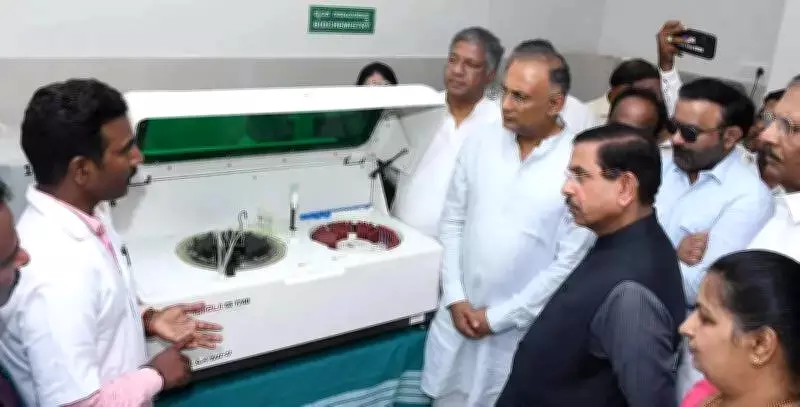
Dharwad: Health and Family Welfare minister Dinesh Gundu Rao on Monday asserted that there is no shortage of medicines in any government hospital and said the state is strengthening healthcare infrastructure to deliver quality services to the public. He was speaking after inaugurating a new vaccination centre at the district health and family welfare office and the district integrated public health laboratory at the district hospital campus.
He added that adequate stocks of essential medicines are being maintained across health facilities. Acknowledging staff shortages in the health department, he said services are being managed through shifts, and recruitment of 225 specialists has already been initiated. Union minister Pralhad Joshi said the Centre is prioritising strengthening public health systems, and stressed the importance of developing vaccine storage infrastructure with well-equipped facilities. Under the Pradhan Mantri Ayushman Bharat Health Infrastructure Mission (PM-ABHIM), an outlay of Rs 64,180 crore has been allocated nationwide. The scheme includes 17,788 rural Ayushman Arogya Mandirs, 11,024 urban health centres, 3,382 block public health units, 744 district laboratories, and 621 critical care hospital blocks.
According to the minister, Karnataka has received administrative approval of Rs 1,928.8 crore under the scheme from 2021–22 to 2025–26. Minister Lad said the district hospital is delivering effective healthcare, supported by new medical facilities.

Integrated Lab Facility
The district integrated public health laboratory, established under the PM-ABHIM scheme at a cost of approximately Rs 1.1 crore, will provide comprehensive diagnostic services under one roof. Healthcare institutions, including PHCs and taluk hospitals, can send samples to the facility. The laboratory offers services in biochemistry, pathology, microbiology, and serology. By centralising services, it aims to ensure efficient management and faster test results. District surgeon Dr Sangappa Gabi said patients need to provide a sample only once, after which all required tests will be conducted at the facility.