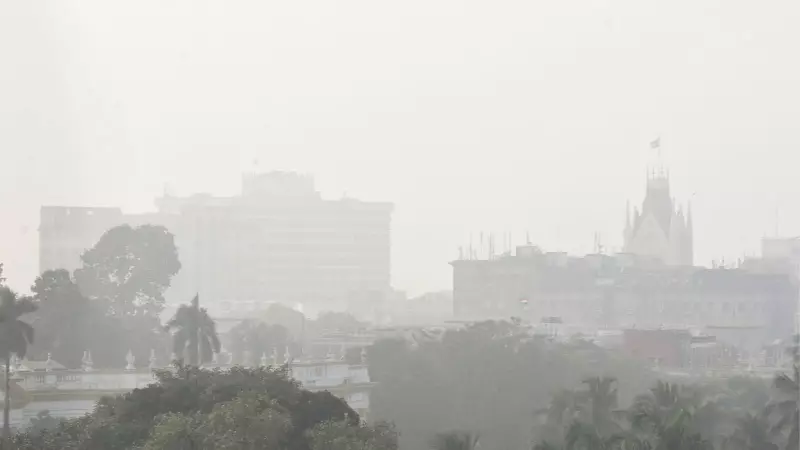
Kolkata, the City of Joy, is choking. The romantic winter mist that once defined its December charm has been unmasked as a dangerous blanket of particulate pollution. While political energies are consumed by election campaigns and identity politics, a silent, slow-burning emergency engulfs the city's skies, with real-time data painting a grim picture of neglect.
The Data Doesn't Lie: A City Gasping for Air
Machines monitoring Kolkata's atmosphere are delivering alarming readings. Real-time data from air-quality stations around the Victoria Memorial belt consistently shows air slipping into the 'very poor' category. The situation peaked dramatically on December 12, 2025, when the Air Quality Index (AQI) hit a severe 366. This is not an isolated spike but part of a persistent pattern.
The drivers of this pollution are multifaceted. Dust from relentless roadwork and foot traffic, dry soil, and the winter meteorological phenomenon known as inversion—which traps pollutants close to the ground—combine to create a toxic mix. According to a 2019 source-apportionment study by CSIR-NEERI, commissioned by the West Bengal Pollution Control Board (WBPCB), the winter pollution pie is divided starkly: secondary aerosols contribute 32%, vehicles 25%, wood burning 15%, and coal 9%.
A Political Vacuum Amidst an Election Climate
As West Bengal marches towards another Assembly election, the campaign climate is thick with debates over central-state relations, identity, and religious narratives. However, the quality of the air citizens breathe is conspicuously absent from mainstream political rhetoric. Smog lacks a dramatic 'moment'; it is a creeping catastrophe, making it easy for authorities to sideline.
The global air quality report by IQAir underscores the scale of the problem. Kolkata's annual average PM 2.5 concentration in 2024 was 45.6 micrograms per cubic metre. This staggering figure is nearly nine times the World Health Organisation's (WHO) recommended safe limit. In a functioning democracy, such a statistic would trigger urgent legislative debate and action. In Kolkata, it barely trends on social media, let alone the political agenda.
Reports from Down To Earth indicate that air toxicity in Kolkata sees a sharp increase once PM 2.5 levels cross approximately 70 µg/m³. Alarmingly, this threshold was breached on nearly three-fourths of all winter days during the study period.
Denial, Blame-Game, and the Path Forward
The administrative response often mirrors a well-rehearsed art of denial and deflection. The central government places the onus on states, the state government points to transboundary pollution, and municipal bodies cite jurisdictional limits. This cycle ensures everyone is partially right and, consequently, fully unaccountable.
Visible, politically safe actions like deploying sprinkler trucks and anti-smog guns before VIP visits or conducting sweeping drives target only dust. However, they fail to address the core issue. Secondary aerosols, which form nearly a third of the pollution, cannot be swept away. They require systemic, region-wide regulation of fuels, vehicles, and waste burning—measures deemed politically costly, especially in an election year.
Experts and studies, including warnings from the World Bank, unanimously prescribe a coordinated approach: phasing out old, polluting vehicles, stringent control of open burning, monitored construction activities, treating Kolkata and Howrah as a single airshed, and transparent, real-time enforcement data publication. However, these policies demand public pressure, and pressure demands political will.
Imagine if every dangerous spike in PM 2.5 levels demanded a ministerial statement with the same urgency as a dispute over central-state fund releases. That would be politics worthy of India's second-most-polluted metropolitan area. Until air quality becomes a non-negotiable campaign question, Kolkata's December sky will remain a dull, hazardous grey—a cocktail of dust, smoke, and collective denial. The poetic fog has turned poisonous, and the silence surrounding it is not ignorance but a form of tragic consent.