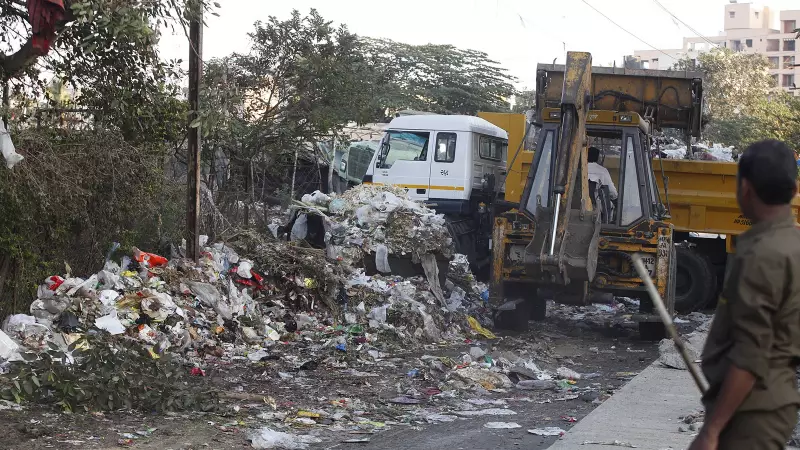
Despite a hefty financial penalty, a decades-old toxic dumping ground in Mohali continues to pose a severe health hazard to thousands of residents, exposing the critical gap between regulatory action and on-ground enforcement.
A Penalty Without Protection
The Punjab Pollution Control Board (PPCB) imposed a Rs 65-lakh fine on the Municipal Council in Kharar, Mohali, for repeated violations of the Solid Waste Management Rules, 2016. This penalty covered violations from July 1, 2020, to June 30, 2025. However, this financial slap has done little to alter the grim reality for nearly 6,000 residents of Darpan City and adjoining colonies living next to the 45-year-old dump site near Khanpur Kharar.
Even six years after serious lapses were officially flagged, the site remains a source of daily poison. Recent days have seen a major fire at the dumping ground, releasing thick, toxic smoke across residential areas. "This is not smoke, it is poison," said local resident Rakesh Bhardwaj. "Children, the elderly, and people with asthma and bronchitis are struggling to breathe. What does a Rs 65-lakh fine mean if people's lungs are being damaged every day?"
Ignored Directives and Deep-Rooted Negligence
An RTI application filed by Bhardwaj revealed that the PPCB had issued clear directives to the Municipal Council as early as August 7, 2019, ordering immediate corrective measures. These orders were ignored. A subsequent PPCB RTI response dated December 24 confirmed the penalty was due to persistent non-compliance at a site located dangerously close to homes.
Internal PPCB inspection reports from 2019 outlined multiple violations: the dump violates mandatory siting norms, sits within a residential zone, operates without statutory authorisation, and lacks piezometers to monitor groundwater contamination. Residents also question how housing projects like Darpan City were approved next to a dump that has existed for over four decades, pointing to systemic administrative failure.
During hearings, the civic body promised measures like herbal spraying, green belts, and boundary wall construction. Ground inspections, however, revealed a starkly different picture: collapsed walls, overpowering stench, unscientific dumping, and garbage spilling into residential lanes. Contaminated leachate continues to leak through broken walls into streets and homes.
Health Crisis and Official Promises
The direct consequence is a sharp rise in health complaints among residents, including breathlessness, chest tightness, and eye and throat irritation. The community has demanded an immediate inspection, emergency pollution-control measures, repaired containment structures, and a clear, time-bound remediation plan.
When contacted, Sukhdev Singh, Executive Officer of the Municipal Council, Kharar, stated that the Rs 65-lakh penalty was imposed earlier and does not pertain to the current period. He claimed a large portion of accumulated waste has been processed and that a high-capacity electricity connection is now installed. He asserted that heavy machinery will become operational within one to two days.
This new setup, according to the officer, will have the capacity to process around 1,000 metric tonnes of waste daily, with the entire existing stock cleared within three months. He promised systematic and scientific waste management thereafter and said state government directives are being implemented. Regarding the damaged boundary wall, he said a tender for reconstruction has been floated and work will begin post-tender completion, expressing confidence that these measures will resolve residents' problems.
Past relocation plans to Badali, Aujla, and Jandpur failed due to public opposition and legal hurdles, leaving authorities with no alternative. The situation underscores a painful truth: without strict enforcement and accountability, financial penalties remain a paper tiger, while citizens pay the price with their health.