

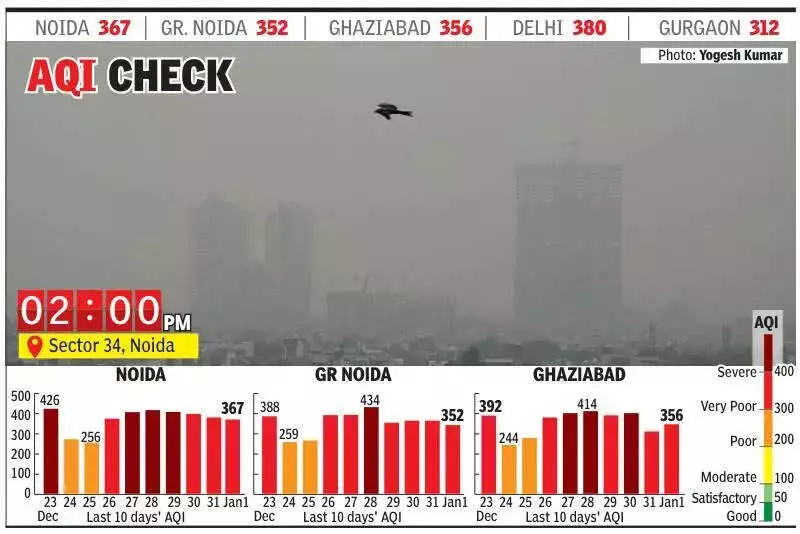
The National Capital Region (NCR) continued to gasp for breath on Thursday as air quality persisted in the 'very poor' category, accompanied by dense morning fog that severely hampered visibility. While there was a marginal improvement in some areas compared to the previous day, the overall situation remained grim, with weather conditions likely to keep pollution levels elevated in the coming days.
Air Quality Stagnates in 'Very Poor' Zone
Noida recorded an Air Quality Index (AQI) of 367, showing a slight dip from Wednesday's reading of 382, but still firmly in the 'very poor' bracket. Its neighbour, Greater Noida, followed a similar trend with an AQI of 352, down from 366 on Tuesday. In a concerning shift, Ghaziabad witnessed a deterioration in air quality, with the AQI climbing to 356 from 312, also landing in the 'very poor' category.
Station-level data, though not updated on the Central Pollution Control Board (CPCB) portal, was available via the Sameer App. It revealed a widespread problem across Noida: Sector 1 recorded an AQI of 381, Sector 116 at 370, Sector 125 at 360, and Sector 62 at 357. All these readings fall under the 'very poor' classification. In Greater Noida, Knowledge Park V registered 371 and Knowledge Park III stood at 334.

The situation was particularly severe in parts of Ghaziabad. Loni and Vasundhara entered the 'severe' category with alarming AQI levels of 407 and 404 respectively. Other areas like Sanjay Nagar (329) were 'very poor', while Indirapuram (286) was in the 'poor' category.
Fog and Calm Winds Worsen Conditions
The air quality crisis was compounded by dense fog that enveloped the region on Thursday morning. Visibility dropped drastically to between 50 and 200 meters, disrupting daily life and transport, before improving later in the day. Meteorological factors played a key role in trapping pollutants.
According to the Indian Institute of Tropical Meteorology (IITM), surface winds were predominantly from the south-east during afternoon hours, with speeds reaching up to 10 kmph. However, wind speeds dropped to less than 5 kmph from the north-east direction during the evening and night, creating calm conditions that prevent the dispersion of harmful particles.
Delhi's Plight and the Forecast Ahead
Delhi's air quality remained at the higher end of the 'very poor' spectrum. The 24-hour average AQI was recorded at 380 at 4 PM, slightly worse than Wednesday's 373. The capital experienced unusual temperature patterns; the minimum temperature settled at 10.6 degrees Celsius, four degrees above normal, while the maximum was 17.3 degrees Celsius, two degrees below normal.
The forecast offers little respite. Authorities predict that air quality is likely to stay in the 'very poor' range for the next few days. For Friday, the city is expected to see a partly cloudy sky with moderate to dense fog in the morning. Winds are predicted to be calm, blowing from the north-west at speeds around 5 kmph in the morning, increasing to nearly 10 kmph in the afternoon, and dropping again below 6 kmph by evening. Weather analysts have also forecast a sharp dip in minimum temperatures starting January 4th.
The combination of low wind speed, fog, and falling temperatures creates a perfect recipe for pollution to accumulate, posing continued health risks for residents across Noida, Ghaziabad, and Delhi.






