

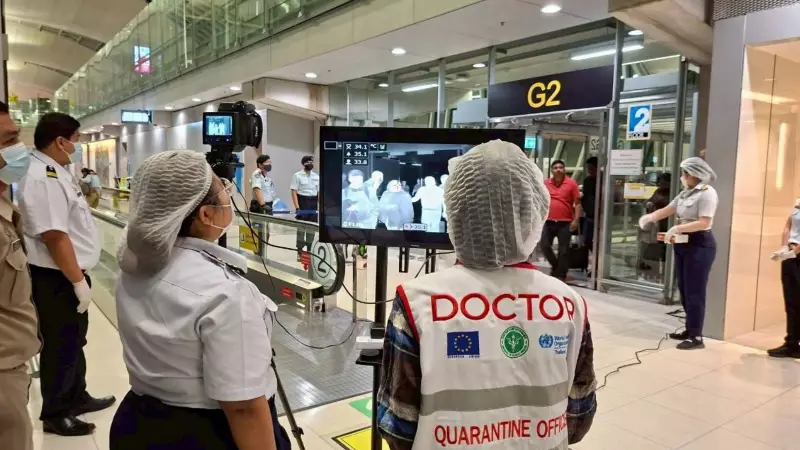
Health Ministry Clarifies Nipah Situation Amid Heightened Airport Screening
As multiple Asian airports reintroduced COVID-style health screening measures following reports of Nipah virus cases in India, the Union Health Ministry has issued a detailed clarification regarding the actual situation. The ministry confirmed that only two confirmed cases of Nipah Virus Disease (NiVD) have been reported from West Bengal since December of last year, with all traced contacts testing negative for the infection.
Official Statement Dispels Speculative Reports
The health ministry explicitly addressed what it called "speculative and incorrect figures" circulating in certain media sections. In an official note, the ministry stated: "It has been observed that speculative and incorrect figures regarding Nipah Virus Disease cases are being circulated in certain sections of the media. In this context, it is clarified that, as per reports received from the National Centre for Disease Control, only two confirmed cases of Nipah Virus Disease have been reported from West Bengal from December last year till date."
The ministry emphasized that following confirmation of these two cases, the Government of India, in close coordination with the West Bengal government, initiated prompt and comprehensive public health measures according to established protocols.

Comprehensive Contact Tracing and Surveillance
A total of 196 contacts linked to the confirmed cases were identified, traced, monitored, and tested, according to the health ministry's statement. All traced contacts were found to be asymptomatic and tested negative for Nipah Virus Disease.
The ministry detailed the containment efforts: "Enhanced surveillance, laboratory testing, and field investigations were undertaken through coordinated efforts of Central and State health agencies, which ensured timely containment of the cases. No additional Nipah Virus Disease cases have been detected so far."
Understanding Nipah Virus and Transmission
Nipah is a viral infection that primarily affects animals including bats, pigs, dogs, and horses, but can jump to humans who come into contact with infected animals. The virus can be transmitted through contaminated food items such as fruit or date palm sap that has been contaminated with bodily fluids of infected animals, typically bats.
The disease usually presents as fever and swelling of the brain (encephalitis) and can be highly fatal. However, health authorities note that Nipah is not as transmissible as COVID-19 or influenza and is unlikely to cause a large number of infections in a short period.
Government Preparedness and Treatment Options
The Indian government maintains a reserve of monoclonal antibodies imported from Australia during last year's Nipah outbreak in Kerala. While these monoclonal antibodies haven't undergone complete human trials to prove effectiveness against Nipah, the government has permitted their use on compassionate grounds.
There is currently no established effective treatment for Nipah virus disease, which kills between 40% to 75% of those infected. Each infected person requires two doses of the monoclonal antibody treatment, which must be administered in the early stages of the disease before brain swelling (encephalitis) develops.
Research Progress and Future Prospects
In recent research, monoclonal antibodies have emerged as a promising treatment approach for Nipah virus. These therapies are designed to block the virus from entering host cells by targeting specific viral proteins, with certain candidates showing success in preclinical models including preventing lethal infections in non-human primates.
Specific monoclonal antibodies like MBP1F5 and m102.4 have demonstrated potential in research settings. These therapies aim to reduce viral load early in infection, offering a critical defense against Nipah's high fatality rate. However, ongoing research and human trials are necessary before these treatments become widely available.

Call for Responsible Information Sharing
The health ministry insisted that the situation remains under constant monitoring with all necessary public health measures in place. Officials urged the public and media to "rely only on verified information released by official sources and to refrain from spreading unverified or speculative reports."
The clarification comes as airports in Thailand, Taiwan, and Nepal have implemented enhanced health screening measures for travelers, reflecting international concern about potential virus spread despite India's containment efforts.





