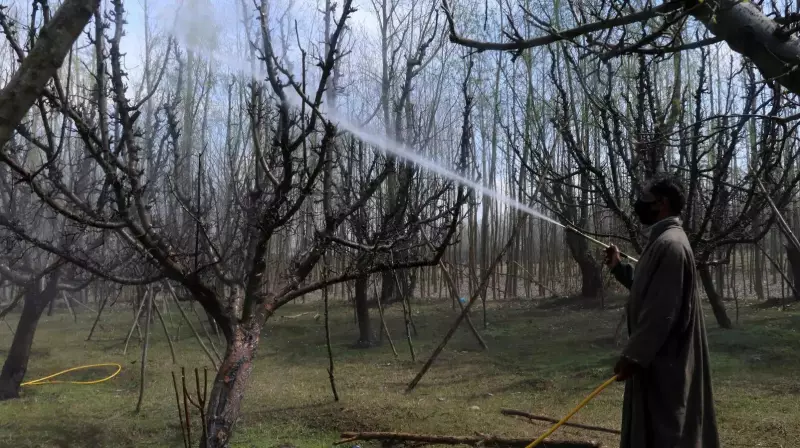
Lawmakers and medical experts in Jammu and Kashmir are sounding the alarm over a potential public health crisis, as evidence mounts linking prolonged pesticide use in the region's famed apple orchards to a disturbing rise in malignant brain tumours among workers. The House Committee on Environment of the Jammu and Kashmir assembly, led by CPM legislator MY Tarigami, has initiated a fresh examination of the health hazards faced by those who form the backbone of the Valley's billion-rupee apple economy.
Scientific Evidence Points to a Disturbing Correlation
The committee's scrutiny revisits critical findings from a study conducted by the prestigious Sher-i-Kashmir Institute of Medical Sciences (SKIMS). This research, which analysed over 400 cancer patients between 2005 and 2008, reported high incidences of primary brain cancer in the core fruit belt districts of Baramulla, Anantnag, Budgam, Shopian, and Kupwara. The study identified a "quite strong and possible" link between pesticide exposure and the development of malignant brain tumours in orchard farmers.
Despite being largely ignored upon its initial publication, the SKIMS research has gained renewed urgency. A subsequent study published in the Indian Journal of Occupational and Environmental Medicine revealed that a staggering 90% of brain tumour patients from Kashmir's orchard belts had a history of pesticide exposure. All these cases involved high-grade, aggressive tumours, with a recorded mortality rate of 12% among the exposed group.

Overuse of Chemicals and Systemic Failures
Scientists presenting to the legislative committee highlighted reckless practices that exacerbate the danger. Shahid Rasool, principal scientist at CSIR–Indian Institute of Integrative Medicine, stated that pesticide use frequently exceeds recommended limits. Many orchardists spray chemicals every 10 to 12 days instead of the advised 18 to 21-day interval, mistakenly believing it increases yield.
The risk is compounded by a near-total lack of protective gear. "Few can afford protective gear; chronic cough, rashes and irritation are common. Without gloves, goggles and masks, the risk multiplies," Rasool warned. He noted that farmers now use up to 15 rounds of fungicide and insecticide each season, far beyond any recommended schedule.
Pesticides in the Bloodstream: A Deeper Health Crisis
The health implications extend beyond cancer. Dr. Sobia Nisar, a physician-researcher at Government Medical College, Srinagar, has studied the biochemical effects on residents of apple-growing districts like Shopian and Pulwama. Her investigations, initially aimed at checking fruit for pesticide residue, uncovered something more alarming: traces of these toxic compounds in human blood samples.
Her findings document not only pesticide residues in the bloodstream of workers and nearby residents but also correlate exposure with higher rates of obesity, lipid disorders, metabolic syndrome, and early signs of kidney impairment. "When such patterns emerge consistently across populations exposed to pesticides, it demands urgent scientific scrutiny," Dr. Nisar emphasized.
The SKIMS study provided granular data, analysing 432 patients with primary malignant brain tumours against 457 control patients. It found that exposed patients had contact with multiple neurotoxic chemicals like chlorpyriphos, dimethoate, mancozeb, and captan. Alarmingly, nearly a third (31.9%) of the pesticide-exposed cancer patients were under 40 years old, indicating early-life exposure.
A Call for Policy Intervention and Safety Reform
Confronted with this evidence, the House Committee on Environment has committed to recommending concrete policy measures to the health and horticulture departments. The focus will be on enhanced monitoring, dedicated research funding, and crucially, ensuring worker safety. Committee Chairman MY Tarigami struck a cautious but determined tone: "We don't want to create panic among farmers... But neither can we sit idle when data indicates a serious health hazard. If pesticide spray is harming lives, it must be addressed."

The issue is magnified by the scale of Kashmir's apple industry, which contributes over 70% of India's total apple production and directly or indirectly involves around 40% of the Valley's population. With millions of tonnes of chemicals sprayed annually and a documented rise in high-grade tumour admissions over the past three decades, the call for action to protect the health of the farming community has never been more critical.