

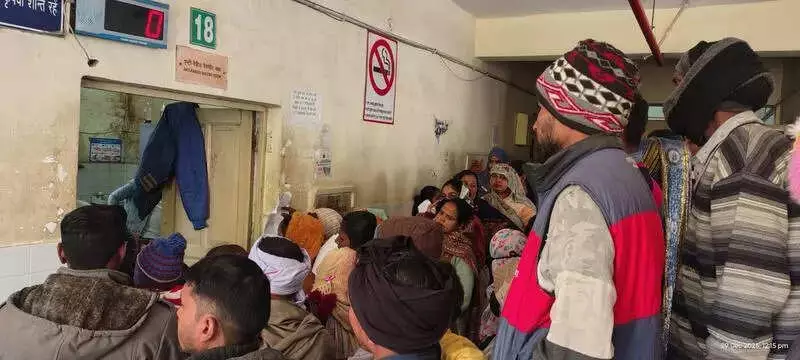
A wave of panic has gripped Pipraul village in Uttar Pradesh's Badaun district, leading to a massive rush at a local health centre. More than 200 residents have queued up in large groups seeking precautionary anti-rabies vaccinations. The fear stems from a widespread speculation linked to a funeral feast held last month.
The Source of the Panic: A Funeral Feast
The incident traces back to December 23, when a feast was organised in memory of a late resident, Oran Sahu. The 'tehravi' ceremony saw attendance from villagers of Pipraul and nearby settlements. A key side dish served was 'raita', a yogurt-based preparation.
According to locals, the milk for the raita came from a buffalo owned by Sahu's cousin. Three days after the feast, the buffalo died. This event triggered alarm as villagers began to speculate that the animal had succumbed to rabies after being bitten by a stray 'mad' dog. The fact that the dog was never found and the buffalo was buried without a postmortem examination only fueled the anxiety.

Village Life Disrupted by Fear
The uncertainty has caused significant disruption in the village, which has an official population of around 1,800. Deepak Kumar, husband of village pradhan Renu Devi, described the scene. "People are anxious because no one knows much about rabies, and there is more hearsay than facts spreading here," he said.
He confirmed that nearly 250 residents had already taken the vaccine, with more lining up. "Most of them have left all their work to get this done first," Kumar added, highlighting the level of concern. The local health administration has responded by stationing a medical team in the village to monitor the situation and counsel residents.
Official Response and Medical Clarification
Health authorities are vaccinating anyone seeking precautionary protection. Dr Rameshwar Mishra, Badaun's Chief Medical Officer, provided details: "In two days, 247 residents from Pipraul came to our facility for vaccinations en masse. On Monday alone, 110 people got the shots." He emphasised that counselling is underway to advise villagers not to panic.
Meanwhile, experts have stepped in to address the core misconception. Dr Abhijeet Pawde, principal scientist at the Indian Veterinary Research Institute (IVRI) Polyclinic, clarified the scientific standpoint. "Studies so far do not conclusively show milk consumption as a mode of rabies transmission," he stated.
He explained that no scientific literature confirms rabies passing into milk in such scenarios. "Transmission risk is higher via direct exposure to saliva or tissue," Dr Pawde noted, aiming to dispel the unfounded fear that has gripped the community.
The incident underscores the critical need for accessible public health education in rural areas to combat misinformation and prevent such large-scale panic over disease transmission.






