

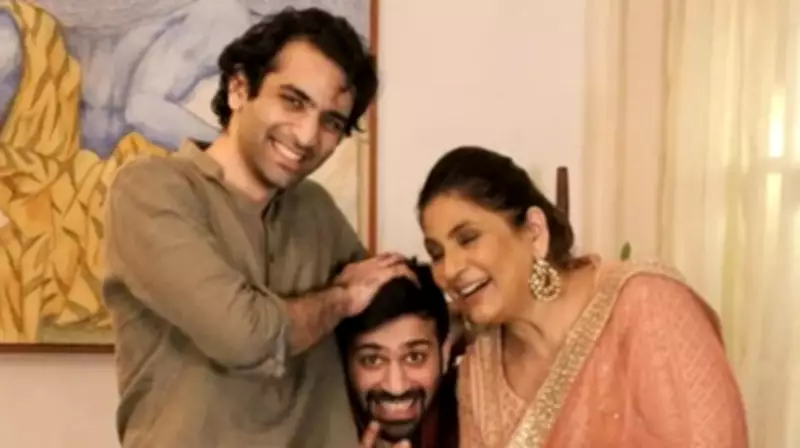
Aryamann Sethi's Candid Confession: From Football Promise to Mental Health Struggles
Aryamann Sethi, the son of renowned actors Archana Puran Singh and Parmeet Sethi, has recently shared a deeply personal account of his mental health challenges and the physical setbacks that ultimately ended his aspirations of becoming a professional football player. In a heartfelt vlog, Aryamann opened up about his journey, revealing the emotional toll of competitive sports and the isolation he felt growing up as a celebrity child.
The Promising Football Career Cut Short by Injury
Aryamann's football journey began with remarkable promise. He was recognized as the second-fastest under-13 football player in Maharashtra and achieved a significant milestone by scoring four goals against Pakistan while representing India in an international match. His mother, Archana Puran Singh, vividly recalled the pride she felt when his coach called to share the news of his exceptional performance. "I was like, 'Oh my God!'" she exclaimed, reflecting on that proud moment.
His talent was undeniable, with Aryamann scoring nine goals in six games during one particularly strong period. This success fueled his dream of playing in the English Premier League, a goal his mother actively supported by securing him a trial at Queen's Park Rangers in England. The club's feedback was encouraging, suggesting they would have given him a chance if he were a local player, prompting the family to arrange for his schooling abroad to pursue this opportunity.

The Devastating Injuries That Changed Everything
However, Aryamann's football dreams were shattered by a series of severe injuries. After moving to London, he suffered a hairline fracture in his leg, forcing him to return to India. The situation worsened when, while playing for Maharashtra again, his leg shattered right in front of his parents. "I couldn't get up. I was terrified that my parents would be angry with me," he recalled, describing the moment he realized his football career might be over.
Despite the devastating injury, Aryamann's determination led him back to England with a rod in his leg from surgery. He continued to play even as his wound bled, but his performance suffered dramatically. "In my second year there, people thought I had bought my place in the club because I had become so bad," he shared, expressing the hurt of being judged unfairly after his earlier selection was based on merit.
The frustration was palpable as he described crying on the field because his body could no longer keep up with his mind. "My brain knew what to do, but my body was three steps behind. It was incredibly frustrating," he admitted, highlighting the emotional struggle of losing his physical capabilities in a sport he loved.
Mental Health Battles and Emotional Turmoil
Aryamann's football journey was intertwined with significant mental health challenges. He revealed that his "darkness became harder to deal with" when he started playing football, attributing this to the extremely competitive environment of sports. "Because I have heightened emotions, I am also hyper-competitive. I wanted to be the best and that drove me," he explained.
He also spoke candidly about being bullied by older players during his early days in football, an experience that later influenced his own behavior. "I was bullied, and then I bullied others. When I look back on my life, I feel like I grew up around so much aggression that it became difficult for me not to be aggressive," he confessed, expressing regret for his past actions.
Growing up as the child of well-known public figures added another layer of difficulty. "I was always an outsider. People looked at me like, 'Oh, he is a celebrity's son.' I was the 'rich kid' to them. I was always kept at a distance," he said, describing the isolation he felt. This sense of being different extended to his experiences studying in the United Kingdom, where he faced bullying and racism. "In England also, I felt like I was fighting the world," he recalled.

Family Dynamics and Therapeutic Insights
Aryamann's emotional struggles were further compounded by family tensions during his childhood. "Mom and dad were not in a good space at that time. I would see them fight. It was all too much to take. I felt like I was fighting the world," he revealed, explaining how unresolved pain manifested as anger.
Through therapy, he has begun to understand these connections. "I have realized that I hurt people when I am going through pain. Anger is pain," he said, describing how therapeutic exercises like talking to his anger have helped him process his experiences. His mother noted his sensitive nature, sharing that "he never forgets if he has hurt anyone" and that this guilt even influences his vegetarian lifestyle and reluctance to harm insects.
A Journey of Resilience and Self-Discovery
Despite the end of his football career, Aryamann's story is one of resilience. From his early success on the field to his training in an academy connected to football star Raheem Sterling, he demonstrated dedication and talent. His willingness to speak openly about mental health, bullying, and the pressures of growing up in the public eye offers valuable insights into the challenges faced by young athletes and celebrity children alike.
As he continues his therapeutic journey and builds his presence through YouTube, Aryamann Sethi's candid revelations serve as a powerful reminder of the importance of mental health awareness in sports and beyond. His experience highlights how physical injuries can have profound emotional consequences and how competitive environments can exacerbate existing mental health struggles.





