

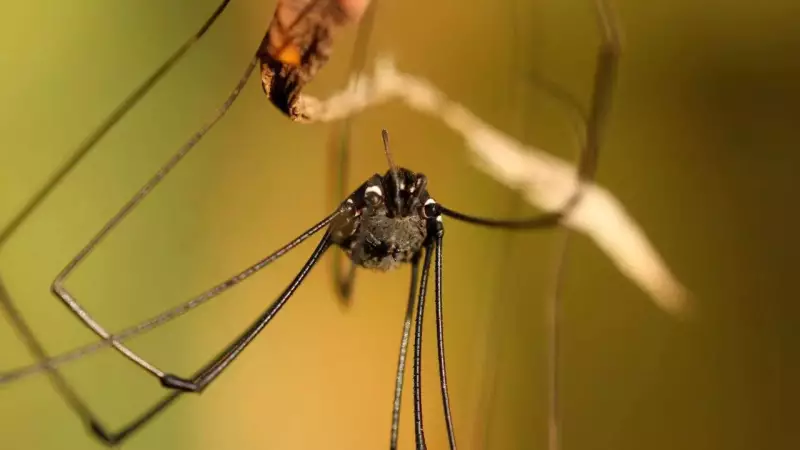
Have you ever spotted a daddy longlegs spider scuttling across your garden wall and felt something was not quite right? Despite having eight legs, it often seems to stroll along using just six. This common observation, which many mistake for an injury or odd defect, is actually a perfectly normal and clever evolutionary design.
The Science Behind the Six-Legged Stride
Contrary to popular belief, the spider is not ignoring two of its limbs. A peer-reviewed study published in the journal Proceedings of the Royal Society B provides the definitive answer. Researchers found that in creatures commonly called daddy longlegs, particularly harvestmen, the second pair of legs is structurally specialised for a purpose other than walking.
These legs are packed with sensory receptors and function primarily as environmental scanners. They are often held aloft, gently sweeping the air or lightly tapping surfaces as the animal moves. This allows the spider to navigate, detect obstacles, and sense vibrations, especially in the low-light conditions it often prefers.

Harvestmen vs. Cellar Spiders: Clearing the Confusion
Part of the mystery stems from the name "daddy longlegs," which is used loosely. Indoors, it frequently refers to cellar spiders. However, the distinctive three-pair walking behaviour is most strongly associated with harvestmen, which are often seen in gardens and fields.
While both are arachnids, harvestmen belong to a different scientific group. A key difference is their body shape: harvestmen have a single, rounded body, unlike the two-segmented body with a narrow waist that spiders possess.
An Efficient Division of Labor
This unique walking style represents a brilliant division of labor among the limbs. While the six sturdier legs handle the tasks of support, balance, and propulsion, the long, flexible front pair acts as a sophisticated sensory array.
This strategy offers several advantages:
- Enhanced Awareness: The sensing legs probe ahead, allowing the spider to "feel" its way forward and avoid danger before committing its body.
- Protection: By keeping these delicate, highly segmented legs off the ground, the spider minimises wear and tear and the risk of breakage.
- Stability: Six legs provide a very stable platform for movement, even on uneven terrain like leaf litter and bark, which is the harvestman's typical habitat.
What appears slow or awkward to human eyes is, in fact, a highly efficient and cautious strategy perfectly suited to a scavenger's lifestyle. Stability and environmental awareness are far more critical than speed.
So, the next time you see a daddy longlegs moving with two legs raised, you'll know you're witnessing a remarkable adaptation. It's not a flaw but a functional masterpiece of evolution, where every limb has a dedicated job, making the creature a master of its shadowy world.






