

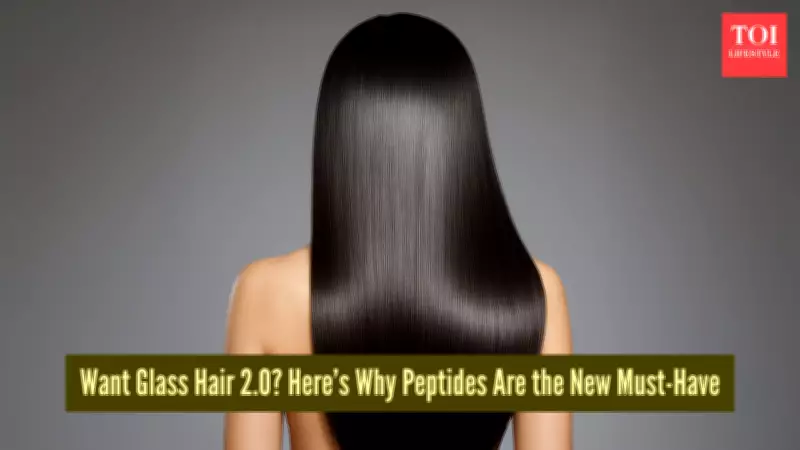
If you frequented beauty counters in 2018, you likely recall the "Glass Hair" craze. That era was defined by sharp bobs, extreme heat styling, and humidity-blocking sprays that essentially laminated hair strands. The look was undeniably striking—a mirror-like, almost synthetic surface—but the approach was fundamentally superficial. We were coating hair in a silicone raincoat to mimic a healthy glow, often concealing underlying dryness and damage.
The Evolution to Glass Hair 2.0
Fast forward to 2026, and the haircare conversation has undergone a radical transformation. We have entered the age of Glass Hair 2.0. While the aesthetic remains similar—characterized by high-gloss, fluid, and blindingly shiny hair—the methodology has shifted dramatically. Instead of relying on surface-level lamination, we are now pursuing "shine from within." The key ingredient driving this change is not a novel oil or silicone, but a powerhouse borrowed from skincare routines: peptides.
Understanding Hair Architecture: Rails vs. Rungs
To grasp why peptides are overshadowing traditional bond builders, it is essential to examine the architecture of a single hair strand. For years, bond builders, often based on maleic acid, have served as a safety net for bleached and damaged hair. Imagine your hair structure as a ladder. Traditional bond builders function like superglue for the horizontal "rungs," effectively cross-linking broken disulfide bonds to prevent hair from snapping. However, exclusive reliance on them can lead to "protein overload," resulting in stiff, brittle hair if moisture is insufficient.

Peptides, which are short chains of amino acids that mimic natural keratin, operate at a deeper level. Rather than merely patching up the rungs, they penetrate the cortex to reconnect polypeptide chains—the vertical "rails" of the ladder. These microscopic puzzle pieces locate gaps within the strands and lock in to restore core integrity. Industry professionals describe the outcome as "soft strength." Hair not only becomes tougher but also regains elasticity, moving with the fluidity of silk instead of the stiffness of straw, essential for the signature "swish" of the Glass Hair look.
The Physics Behind the Glow
How does internal structural repair translate to that dazzling external shine? The answer lies in a basic principle of physics: porosity diminishes reflection. Damaged hair is porous, filled with microscopic holes and rough patches. When light strikes a rough surface, it scatters in multiple directions, known as diffuse reflection, which is why damaged hair appears matte and dull.
Biomimetic peptides revolutionize this by filling those microscopic "potholes" within the hair shaft. By repairing internal gaps, they enable the hair surface to become flat and uniform again. When light hits this restored surface, it reflects back in a single, unified direction, called specular reflection. This is the secret to the "blinding" shine of Glass Hair 2.0—it is not a superficial layer of oil reflecting light, but the inherent health of the hair fiber itself.
The "Skinification" of Haircare Routines
This shift represents the latest chapter in the "skinification" of hair. We are finally treating our scalp and strands with the same sophistication applied to facial skincare. Just as peptides in night creams plump collagen, they are now used in haircare to restore youthful bounce and vitality. Consequently, routines are becoming lighter. Heavy, occlusive oils that weigh hair down in an attempt to fake gloss are being replaced by lightweight, water-based peptide serums and leave-in masks, such as the industry-favorite K18. These products absorb into damp hair without leaving residue, offering a cleaner, smarter path to shine. In 2026, the ultimate filter is simply healthy hair.






