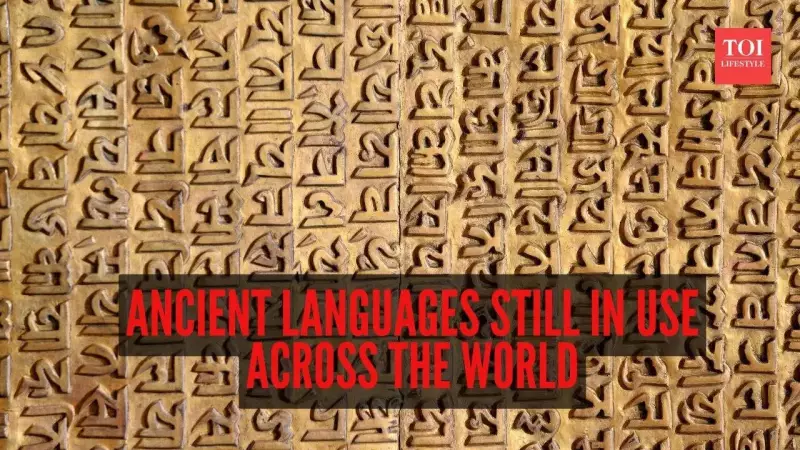
In the ever-evolving tapestry of human civilization, language stands as one of the most resilient threads. While countless tongues have faded into silence over thousands of years, a remarkable few have not only endured but continue to thrive. These ancient languages serve as living archives, carrying forward the wisdom, literature, and traditions of bygone eras into the modern world. Here, we explore ten such linguistic marvels that have braved the test of time.
The Classical Pillars of Asia
Sanskrit, a classical language of India, boasts a lineage extending over 3,500 years. It forms the sacred foundation for Hindu, Buddhist, and Jain traditions. Though not a common vernacular today, its ancient texts like the Vedas and Upanishads are still rigorously studied, and it remains vital for ceremonial and scholarly purposes.
Another titan from the subcontinent is Tamil. With a literary history spanning more than two millennia, it is recognized as one of the world's oldest continuously spoken languages. Thriving in southern India, Sri Lanka, and Singapore, Tamil seamlessly bridges its profound classical heritage with vibrant contemporary use.

In East Asia, Chinese languages, particularly Mandarin, have roots documented for over three thousand years. From inscriptions on oracle bones to its status as one of the planet's most spoken languages today, Chinese represents an unbroken chain of linguistic and cultural evolution.
Ancient Tongues of the Mediterranean and Middle East
The legacy of Greek is awe-inspiring, with a continuous written history exceeding 3,000 years. From the epic poems of Homer to its current use in Greece and Cyprus, the Greek language directly connects modern speakers to a foundational legacy of philosophy, science, and democracy.
Although Latin, born in the Italian peninsula over 2,500 years ago, has no native speakers today, its influence is immortal. It lives on in the realms of science, law, and the Roman Catholic Church, and its vocabulary forms the bedrock of numerous modern European languages.
Hebrew presents a unique story of revival. With origins stretching back three millennia, it was preserved for centuries as a liturgical language before being dramatically revitalized in the 19th and 20th centuries. Today, it is the official spoken language of Israel, used by millions daily.
The Egyptian language, in its latest form known as Coptic, carries a legacy from the era of the pharaohs, with some roots dating back an astonishing 4,000 years. While no longer a language of everyday conversation, it continues to be used liturgically by the Coptic Orthodox Church, preserving a sacred linguistic tradition.
Aramaic, once the lingua franca of the Near East around 3,100 years ago, is now spoken by scattered communities in the Middle East. Its primary modern use is in religious contexts, offering a direct linguistic link to ancient empires and the historical landscape of the region.
Enduring Languages with Global Footprints
Persian (Farsi) has a rich history of over 2,500 years. As the predominant language of Iran (Farsi), Afghanistan (Dari), and Tajikistan (Tajik), its classical poetry and philosophical works remain deeply embedded in the cultural consciousness of these nations.
Finally, Korean has a distinct historical identity dating back at least two thousand years. It is powerfully unified by its unique writing system, Hangul, created in the 15th century, and is spoken by tens of millions in North and South Korea today.
These languages are far more than mere tools for communication. They are vessels of human history, each having navigated centuries of social and political change. Their continued existence, whether in daily speech, sacred ritual, or academic study, allows us a priceless connection to the intellectual and spiritual worlds of our ancestors. They remind us that within words and grammar lies the enduring soul of civilization itself.