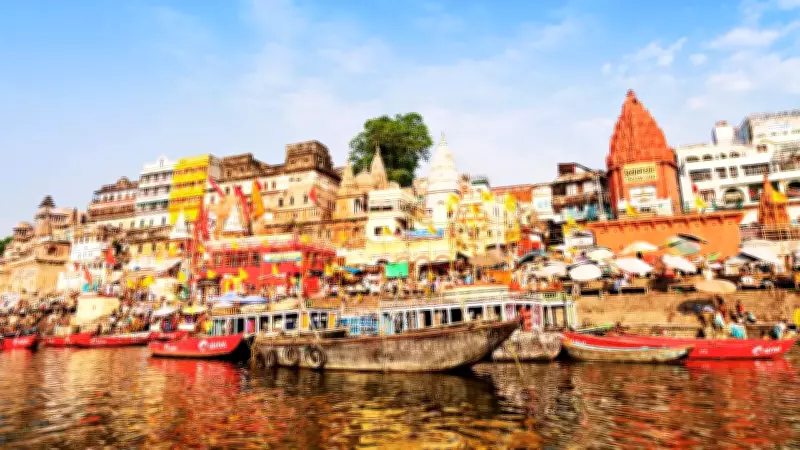
From Shiva's Kashi to Krishna's Dwarka: 10 Indian Cities and Their Patron Deities
India's cities are more than collections of monuments, markets, and neighbourhoods. Many have grown around a sacred presence so powerful that it continues to shape their culture, traditions, festivals, and daily rhythms centuries later. In these cities, the deities are more than just worshipped; their presence adds to the identity of the city itself. The streets come alive through temple festivals, local legends revolve around divine stories, and the communities see themselves as being protected by their patron deity.
Here are ten Indian cities whose identity is closely connected with the deities who reside there.
Varanasi – Lord Shiva
Few cities in the world have such an intimate relationship with a divine entity like Varanasi does with Lord Shiva. Known as Kashi, this ancient city was created by Lord Shiva Himself and serves as His eternal seat on Earth. It is widely believed that dying in Varanasi guarantees liberation from the cycle of reincarnation. The city's religious significance is based primarily on the celebrated Kashi Vishwanath Temple; ghats, temples, and other rites on the banks of the River Ganges further emphasize the fact that Lord Shiva exists everywhere.

Puri – Lord Jagannath
The spiritual life of the city of Puri is inextricably tied with the worship of Lord Jagannath. A form of Lord Vishnu together with his siblings Balabhadra and Subhadra, Lord Jagannath is worshiped at the Jagannath Temple, one of the major pilgrimage sites in all of Hinduism. The magnificent spectacle of the yearly Rath Yatra attracts pilgrims from across India, and the entire city seems to be filled with the power of faith.
Madurai — Goddess Meenakshi
The city of Madurai is one of the oldest living cities in India, and its identity lies in Goddess Meenakshi, a warrior queen and incarnation of Goddess Parvati. The impressive Meenakshi Amman Temple sits right in the center of Madurai. In contrast to other temple cities, the presence of goddesses is significant here, and her annual celestial wedding ceremony is one of the biggest events in southern India.
Mysuru – Goddess Chamundeshwari
On top of the renowned Chamundi Hills lies the temple of Chamundeshwari, the goddess who has ruled over Mysuru for many years. As per legend, she killed the demon Mahishasura and took his name to give this city the name Mysuru. Her influence extends far beyond the temple, especially during the city's world-famous Dussehra celebrations, when Mysuru transforms into one of India's most vibrant cultural spectacles.
Kolkata — Goddess Kali
Kolkata and the fierce goddess Kali are intertwined in a connection that cannot be missed by anyone. For the spiritual essence of the city, one of the main sources of inspiration is the fierce goddess, who is worshiped at the famous Kalighat Kali Temple. While Kolkata is known for literature, art, and intellectual life, it finds its religious essence in the festivities and devotion towards Kali goddess in Durga Puja and Kali Puja celebrations.
Mumbai – Goddess Mumbadevi
One of the biggest cities in India was named after Mumbadevi, the guardian deity of the original inhabitants of the islands, fishermen who were living there. The historic Mumbadevi Temple remains an important spiritual landmark amid the city's skyscrapers and financial districts. It serves as a reminder that behind modern Mumbai lies a much older story rooted in devotion and tradition.
Ujjain — Mahakaleshwar
Of the seven holy cities in India, Ujjain is unique due to the presence of the Mahakaleshwar Jyotirlinga, which is one of the twelve jyotirlingas dedicated to Lord Shiva. The identity of Ujjain cannot be separated from its connection with the age-old Mahakaleshwar Jyotirlinga, where people assemble early in the morning to witness the famous Bhasma Aarti ritual at this place of worship.
Ayodhya – Lord Rama
Ayodhya is considered by Hindus to be the birthplace of Lord Rama, one of their favorite gods. Ayodhya gained importance due to its association with the epic Ramayana. People come to pay their homage to Lord Rama who was also king and walk the same path that he once walked.

Dwarka — Lord Krishna
Dwarka, located on the western coast of Gujarat, is said to be the kingdom formed by Lord Krishna when he left Mathura. It continues to be the most sacred site of Hindu pilgrimage. Dwarkadhish Temple rises majestically against the skyline, a reminder that the seaside city is strongly associated with the legacy of Lord Krishna.
Kanchipuram — Goddess Kamakshi
Kanchipuram, referred to as the “City of Thousand Temples,” has historically been an essential center of Hinduism. One of the significant shrines is the Kamakshi Amman Temple. Kamakshi, an incarnation of Parvati, is considered the patron goddess of the city and is widely revered among Indian worshippers.