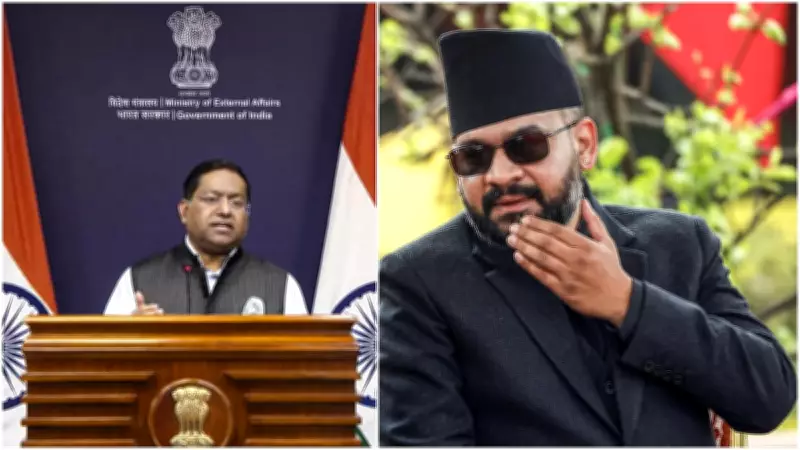
The Ministry of External Affairs (MEA) has categorically stated that no third party has any role to play in resolving the India-Nepal border issue. This statement came in response to Balendra Shah, a prominent figure from Nepal, who recently sought the involvement of the United Kingdom and China in mediating the long-standing boundary dispute.
Background of the Border Dispute
India and Nepal share a deep and multifaceted relationship, but the border issue over the regions of Lipulekh, Limpiyadhura, and Kalapani has been a persistent point of contention. India has consistently maintained that these territories are an integral part of the state of Uttarakhand. The dispute dates back to historical treaties and differing interpretations of the boundary alignment.
India's Stance on Third-Party Mediation
The MEA reaffirmed that bilateral issues between India and Nepal should be resolved through direct dialogue and mutual understanding, without any external interference. The statement emphasized India's commitment to resolving the matter amicably through existing bilateral mechanisms. The government's position is clear: any involvement of a third party would be counterproductive and against the spirit of the friendly relations between the two neighboring countries.

Balendra Shah's Appeal
Balendra Shah, a vocal figure in Nepal, had called upon the UK and China to intervene in the dispute, arguing that their involvement could help bring a fair resolution. However, India's firm rejection underscores its policy of addressing border issues solely through bilateral channels. The MEA's response also highlights the importance of respecting each other's territorial integrity and sovereignty.
Historical Context
The border dispute between India and Nepal is rooted in the interpretation of the 1816 Treaty of Sugauli between the British East India Company and Nepal. The treaty defined the boundary, but certain areas, including Kalapani, Limpiyadhura, and Lipulekh, remain disputed. India controls these areas, while Nepal claims them as part of its territory. The issue has been a subject of periodic diplomatic exchanges and high-level meetings.
Recent Developments
In recent years, the dispute has seen heightened attention, with Nepal's Parliament passing a constitutional amendment in 2020 to update the country's map, including the disputed territories. India rejected the move, calling it a unilateral act not based on historical facts or evidence. Despite the differences, both countries have continued to engage in dialogue to find a mutually acceptable solution.
The MEA's latest statement serves as a reminder of India's consistent position and its preference for bilateral resolution mechanisms. As the two nations navigate this sensitive issue, the focus remains on maintaining peace and stability along the border while strengthening their overall relationship.