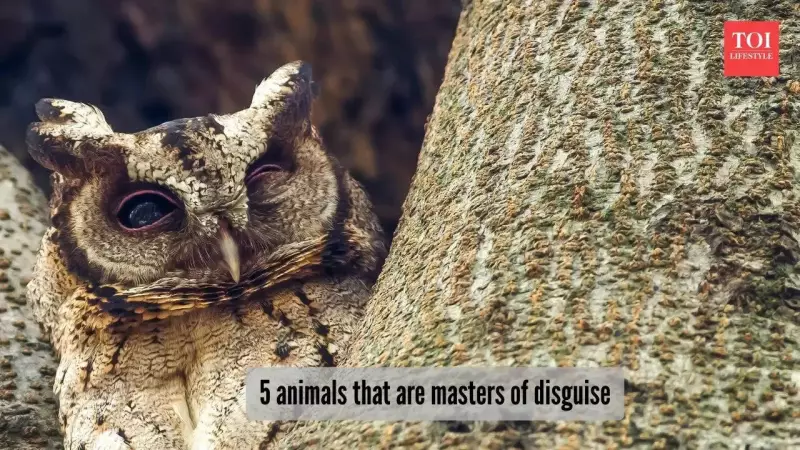
Nature's most incredible survival trick is the art of camouflage, where animals blend so perfectly into their surroundings they become almost invisible. This adaptation, crucial for both hunting and evading predators, showcases the remarkable diversity of life on Earth. From the depths of coral reefs to the icy Arctic plains, creatures have evolved extraordinary methods to disappear in plain sight.
Masters of Disguise: From Trees to Oceans
Camouflage is not a single trick but a range of sophisticated adaptations. Some animals change colour, others mimic textures, and a few even use materials from their environment as a costume. These strategies are vital for survival in the wild.
The Wrap-Around Spider: A Tree Bark Illusionist
Native to Australia and parts of Oceania, the wrap-around spider possesses a uniquely concave belly. This allows it to flatten itself seamlessly around the curves of tree branches. Its abdomen features oval discs that resemble leopard spots, further breaking up its outline against the bark. By day, it remains motionless and undetectable. At night, it becomes an active predator, weaving an orb-shaped web to catch unsuspecting prey. Remarkably, at dawn, it destroys the web and returns to its daytime role, perfectly pretending to be part of the tree.

The Pygmy Seahorse: A Coral Reef Mirage
Among the world's smallest seahorses, the pygmy seahorse measures only a few centimetres. It calls the Coral Triangle of Southeast Asia home. Its body grows calcified tubercles that perfectly mimic the texture of the coral polyps it lives on. Furthermore, it can change its skin colour to match the specific hue of the surrounding coral, offering it exceptional protection from predators. This tiny marine creature is a true master of disguise within one of the planet's most complex and vibrant ecosystems.
The Decorator Crab: A Walking Underwater Garden
Decorator crabs take a proactive approach to camouflage. They literally decorate their shells with pieces of seaweed, coral, and sponges from their habitat. Their shells are covered in velcro-like hairs that firmly hold these decorations in place. Some species go a step further by selecting toxic seaweed or even stinging anemones, which deter predators while the crab itself remains unaffected. When the crab outgrows its shell and moults, it exhibits astonishing behaviour: it carefully transfers its decorations from the old shell to the new one, reusing its camouflage kit.
Seasonal and Desert Disappearing Acts
Camouflage adapts to seasonal changes and harsh environments, proving its effectiveness across climates.
The Arctic Hare: A Vanishing Act in Snow and Stone
The Arctic hare employs a dynamic, seasonal camouflage. Its fur changes from a brown or greyish colour in summer to a brilliant, pure white in winter, allowing it to vanish into snowy landscapes. Its eyes, positioned on the sides of its head, grant it an almost 360-degree field of vision to spot threats. Unique black eyelashes act like natural sunglasses, shielding its eyes from the harsh glare of the sun on snow. This hare is not just hidden; it's also incredibly swift, capable of running at speeds nearing 40 miles per hour, making it a formidable challenge for any predator in its icy domain.
The Sidewinder Rattlesnake: A Desert Ghost
Found in the deserts of the southwestern United States and Mexico, the sidewinder rattlesnake is a master of sandy camouflage. Its skin is a sandy brown with elliptical markings that blend flawlessly with desert rocks and shifting sands. It uses a unique sidewinding motion to move and often buries itself partially in the sand. Raised scales above its eyes act as shields, protecting them from both the harsh sun and blowing sand. This perfect disguise allows it to ambush small rodents, injecting them with venom and then patiently tracking its helpless prey until it succumbs.
These five animals are stunning examples of evolution's ingenuity. Their ability to become one with their environment is a powerful reminder of the endless struggle for survival and the breathtaking beauty of natural adaptation. From the spider that becomes bark to the crab that wears a garden, nature's masters of disguise continue to fascinate and inspire.