Pandas: The Most Human-Like Animals You'll Ever Meet
There is no denying that pandas are among the most adorable creatures in the animal kingdom. It may sound bizarre, but these cute animals share many similarities with humans. From their love for comfort to their dedication to relaxation and even their clumsiness, pandas exhibit behaviors that are hilariously human. Although they belong to the bear family and live deep in the mountain forests of China, pandas display daily habits that feel like looking into a furry, black-and-white mirror. Here are six habits of giant pandas that prove they might be more like us than we think.
Dinner Etiquette
Yes, pandas can leave you amazed by sitting up straight to eat dinner. Most four-legged animals eat by leaning down to the ground, but not the panda. When a panda enjoys a meal, it parks itself squarely on its backside, leaning against a tree trunk or a rock like a person sitting on a living room floor watching television. This upright posture leaves their front paws completely free to handle food. They treat their meal with an almost artistic focus, using an evolved modified wrist bone that acts like a human thumb to grip, rotate, and peel the tough outer layers of bamboo. Watching them systematically strip a bamboo stalk is reminiscent of someone carefully peeling a banana or handling corn on the cob.
Food Coma
For a panda, life centers around two main activities: eating and sleeping. Because their digestive systems are built like a carnivore's, they struggle to break down tough cellulose in plant matter efficiently. To get enough nutrients from a nearly 100% bamboo diet, an adult panda must consume up to 40 pounds of food each day, spending nearly 12 hours munching. Once that mountain of fiber hits their stomach, pandas experience the ultimate food coma. Much like a human crashing on the couch after a massive holiday feast, a panda will drop everything, roll onto its back or stomach, and pass out for a solid two to three hours to let their body process the meal.

Sleep Positions
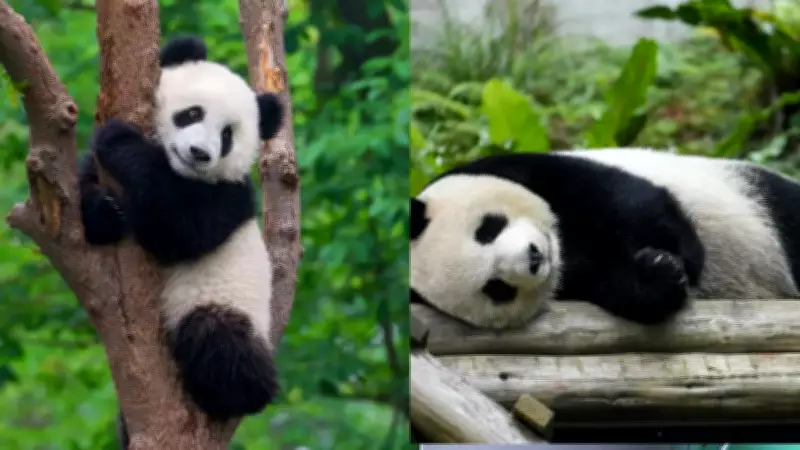
While a standard bear might curl up neatly in a den, a panda treats the entire world as an oversized custom mattress. They are notoriously picky and highly creative about how they get comfortable. You can find them draped face-down over thick tree branches with all four legs dangling into mid-air, wedged upside down between two rocks, or flat on their backs with their paws resting comfortably over their stomachs. If you have ever tossed and turned on a hot summer night trying to find that perfect position where your leg is angled just right over the blanket, you share a soul with a giant panda.
Throwing Tantrums When Frustrated
Pandas may look calm and cuddly, but they possess a flair for the dramatic. When a panda is frustrated, confused, or not getting its way, it does not simply walk away—it throws a full-on toddler tantrum. If a panda cub tries to climb a tree and slips off a branch, it might face-plant into the grass, roll around in a ball, and swat wildly at the air in a fit of pique. Adults are not much better; if a keeper moves a favorite toy or a piece of bamboo is just out of reach, a panda might stomp its feet, flop onto its back, and somersault down a hill out of sheer annoyance.
Choosy About Food
We all have that friend who is an incredibly picky eater—the one who needs the sauce on the side or refuses to eat the crust on their sandwich. Pandas take this trait to an evolutionary extreme. Despite having the biological capability to eat meat, fruits, and other vegetation, they willfully choose to eat bamboo. Even within that choice, they are remarkably snobbish. A panda will not eat just any stalk; they spend minutes sniffing, turning, and inspecting a single piece of bamboo, rejecting dozens of perfectly fine stems until they find one that meets their exact freshness and sweetness standards.

Love for Playing
Pandas are masters of energy conservation, which means they dislike unnecessary work, but they absolutely adore pure, unadulterated play. They love sliding down snowy slopes, rolling down grassy hills like children at recess, and wrestling with giant ice blocks or balls provided by keepers. When they are not playing, they actively practice the art of doing nothing. They sit and stare into space for long stretches, seemingly pondering life's great mysteries—or, more likely, wondering when the next delivery of bamboo is arriving. This balance of playful goofiness and a deep dedication to a low-stress lifestyle is perhaps the most relatable human trait of all.