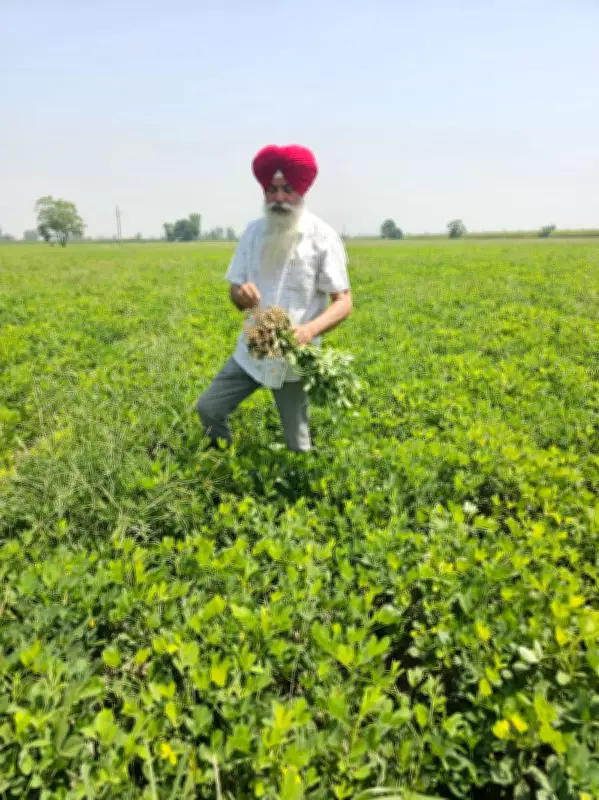
A retired schoolteacher from Kapurthala has emerged as an example of sustainable agriculture, inspiring farmers to embrace groundnut cultivation as a water-saving alternative to spring maize.
Jarnail Singh, a resident of Mothawal village, dedicated his career to teaching before venturing into farming after retirement. He moved to Uttar Pradesh about 13 years ago due to personal reasons, where he successfully cultivated groundnuts on nearly 20 acres of land. Armed with experience, determination and a vision to conserve groundwater, Singh returned to Punjab four years ago with a wish to promote the crop among local farmers.
“I was always in touch with the Krishi Vigyan Kendra (KVK), Kapurthala, and initially sowed groundnuts on a small area during the spring season,” Singh said. “At a time when spring maize, known for its high water consumption, was rapidly expanding, I felt there was a need for a viable alternative. This year, more farmers came forward and sowed TG-24 and J-87 varieties of groundnut.”

Leading by example, Singh expanded groundnut cultivation to 26 acres this year. His efforts have encouraged fellow farmers, resulting in the area under spring groundnut cultivation in Kapurthala district increasing to 72 acres.
Punjab Agricultural University (PAU), Ludhiana, in collaboration with KVK Kapurthala, recently organised a “Field Day and Travel Seminar” in Mothawal village. The event encouraged farmers to adopt spring groundnut cultivation as a means of conserving Punjab’s rapidly depleting groundwater reserves.
Jarnail Singh also mentioned the Assistant Development Officer (ADO) Dr Jaspal Singh for supporting farmers in adopting the crop. “The department helped us procure a groundnut thresher, which is an essential machine for cultivation. Dr Jaspal Singh stood by us and ensured that farmers’ requirements were met,” he said.
Dr Jaspal Singh described groundnut as an excellent substitute for spring maize. “The crop requires much less water and significantly lower input costs. We are working to ensure the availability of quality seeds for farmers during the kharif season so that groundnut cultivation can expand further,” he said.
According to Jarnail Singh, the cost of cultivating groundnut is nearly 50 per cent lower than that of spring maize, making it economically attractive for farmers.
Groundnut, a leguminous crop, offers multiple benefits. Besides requiring considerably less water than maize, it also improves soil fertility by naturally fixing nitrogen.
“Since groundnut is a legume crop, it enriches the soil with nitrogen, reducing the need for urea in the following crop,” explained Dr. Harinder Singh, In-charge of KVK Kapurthala. “With the area under spring maize increasing every year, it is important to provide farmers with a sustainable and profitable alternative.”
Rajya Sabha MP Sant Balbir Singh Seechewal recalled that the Doaba region was once renowned for groundnut cultivation. However, changing weather patterns, declining rainfall and increasing dependence on tube wells led to a gradual decline in the crop’s popularity.
“Punjab’s groundwater can only be preserved if farmers return to traditional crops that are suited to local conditions,” Seechewal said. He lauded Jarnail Singh’s efforts, noting that his initiative has helped bring groundnut cultivation back into focus across the state.
Dr Satbir Singh Gosal, Vice-Chancellor of Punjab Agricultural University, termed the initiative “small but significant.” He highlighted that spring groundnut is a biannual crop that supports soil health while providing attractive returns. The crop can yield between 25 and 28 quintals per acre annually.
As concerns over Punjab’s groundwater crisis continue to grow, farmers like Jarnail Singh are proving that sustainable solutions can emerge from grassroots efforts. By reviving a traditional crop and inspiring others to follow suit, the retired teacher is helping sow the seeds of a more water-secure future for Punjab.