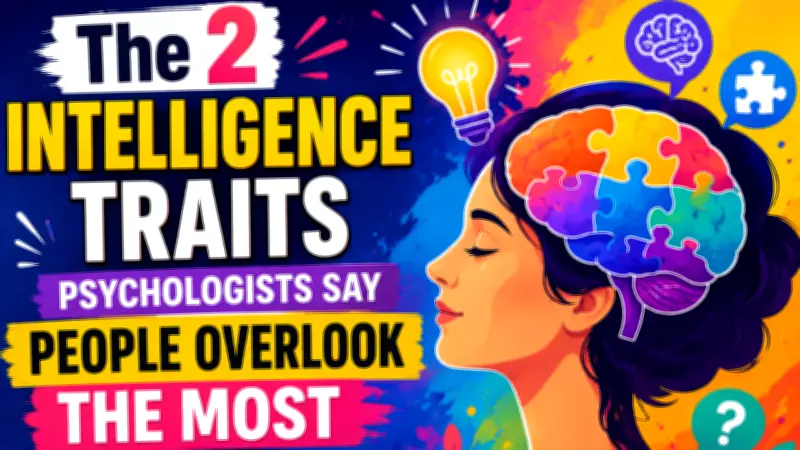
Think about what a 'smart person' looks like in your head. Probably articulate, composed, someone who always has the right answer and never says anything they would regret. This image has been handed down through school, films, and every LinkedIn post about high performers, becoming the default. But psychology keeps quietly dismantling it.
Two Behaviors Linked to Higher Intelligence
Psychologist Mark Travers, writing in Psychology Today, points to two behaviors that people routinely dismiss or actively judge as signs of low intelligence. Research suggests the opposite might be true. Once you hear the reasoning, it is hard to unsee.
Talking to Yourself
Most people who mutter to themselves in public are aware of the looks they get. It reads as distracted, forgetful, or a little odd. We have all probably caught ourselves doing it and felt mildly embarrassed. Psychologists Gary Lupyan and Daniel Swingley ran a study in 2012 that changes how you think about this. They gave participants a visual search task to find a specific object among a group of images, splitting them into two groups. One group spoke the target's name aloud while searching; the other stayed silent. The group that talked found their target significantly faster, consistently, across trials. Lupyan and Swingley described this as the label feedback hypothesis: verbal labels do not just describe the world, they actively shape how we perceive it. When you say a word out loud, you engage your language production system and your auditory processing system simultaneously. The spoken word becomes a perceptual cue that tunes attention and primes the brain for what it is looking for.

So that person muttering 'keys, keys, keys' while ransacking their bag? Their brain is actually being quite efficient. Self-talk is not a symptom of disorganization; it is a tool. Athletes, surgeons, and chess players use versions of it all the time; they just do not get judged for it the same way. A 2023 review went further, finding that self-talk plays a role in emotional regulation, planning, task-switching, and higher-order thinking. That is a fairly long list for something society has spent decades treating as mildly embarrassing.
Swearing
This one is harder to sell. The assumption about swearing is so baked in that it is the verbal shortcut of people who cannot find better words, something most of us absorb without questioning. It feels intuitively right. It is also probably wrong. Travers cites the work of researchers Kristin and Timothy Jay, who studied verbal fluency and found that people who could generate more taboo words also tended to have broader general vocabulary knowledge. The ability to swear well, if you will, tracked with language skill, not against it.
The reason makes sense when you think about how swear words actually work. They are not filler. They carry emotional weight, social context, and a kind of precision that polished language sometimes cannot match. Knowing when to deploy one and which one requires reading a room, understanding register, and having enough command of language to know what ordinary words can and cannot do. That is not a poverty of vocabulary; that is fluency. None of this means constant swearing is a sign of genius. But the old idea that swearing reveals a limited mind? The data does not support it. Interestingly, even when people are shown evidence to the contrary, the stereotype holds. Studies have found that people who swear are still judged as less intelligent and less trustworthy, which says more about the persistence of assumptions than it does about the people being judged.
Why We Keep Getting Intelligence Wrong
The problem is a narrow definition that refuses to loosen its grip. We still reach for the same visible markers: academic credentials, quick answers, polished communication, and professional achievement. While those things can reflect intelligence, they are far from the whole picture. Cognitive ability shows up in problem-solving, memory, adaptability, emotional regulation, and the way a person processes and organizes information. Some of the most capable thinkers are messy communicators. Some of the most articulate people in any room are coasting on presentation rather than depth.

Intelligence, as psychology keeps demonstrating, does not always look the way we expect. Sometimes it sounds like someone talking to themselves in a supermarket aisle. Sometimes it sounds like a well-timed expletive. And the fact that we are still surprised by that probably says something about us, too.