Throughout human history, certain rare and magnificent objects have transcended their material form to become icons of our cultural and artistic legacy. These artifacts, ranging from ancient manuscripts to legendary gemstones, hold such immense historical, cultural, and artistic significance that their value is often considered incalculable. They are not merely expensive items but priceless windows into our past, captivating collectors, historians, and the public alike. Here, we delve into seven of the world's most extraordinary and valuable treasures.
Masterpieces of Art and Genius
Topping the list of the most expensive artifacts ever sold is the Salvator Mundi, a painting attributed to the Renaissance master Leonardo da Vinci. This artwork, depicting Christ as the 'Saviour of the World,' was auctioned in 2017 for a staggering US$ 450.3 million, setting a world record. Its astronomical price stems from its rare da Vinci attribution, the fascinating story of its restoration, and the ongoing debate about its authenticity, which only adds to its global allure.
Another priceless work by Leonardo da Vinci is, of course, the Mona Lisa. Housed in the Louvre Museum in Paris, this iconic portrait has never been offered for sale. However, based on its unparalleled fame, artistic mastery, and cultural impact, experts have estimated its insured value to be over US$ 850 million. It remains the most famous painting on the planet, its enigmatic smile drawing millions of visitors each year.

Beyond paintings, da Vinci's scientific intellect is preserved in the Codex Leicester. This handwritten manuscript contains his detailed observations on water, astronomy, and geology. In 1994, Microsoft co-founder Bill Gates purchased it for US$ 30.8 million, making it one of the most expensive manuscripts ever sold. Its value lies in offering a direct, unfiltered glimpse into the mind of a universal genius.
Royal Treasures and Ancient Legacies
The world of priceless objects extends beyond canvases to include breathtaking craftsmanship. The Badminton Cabinet, an 18th-century masterpiece of ebony, gilt-bronze, and marble, is a prime example. Originally made for the Duke of Beaufort, this extraordinarily elaborate piece of furniture was auctioned in 2004 for approximately US$ 36.7 million, reflecting its supreme artistry and aristocratic provenance.
In the realm of gemstones, few are as legendary as the Hope Diamond. This 45.52-carat deep-blue diamond is shrouded in tales of mystery and curse. Currently displayed at the Smithsonian Institution in Washington D.C., its estimated value ranges between US$ 200 million and US$ 350 million. Its immense worth is driven by its exceptional rarity, unique colour, and storied history of ownership by kings and collectors.
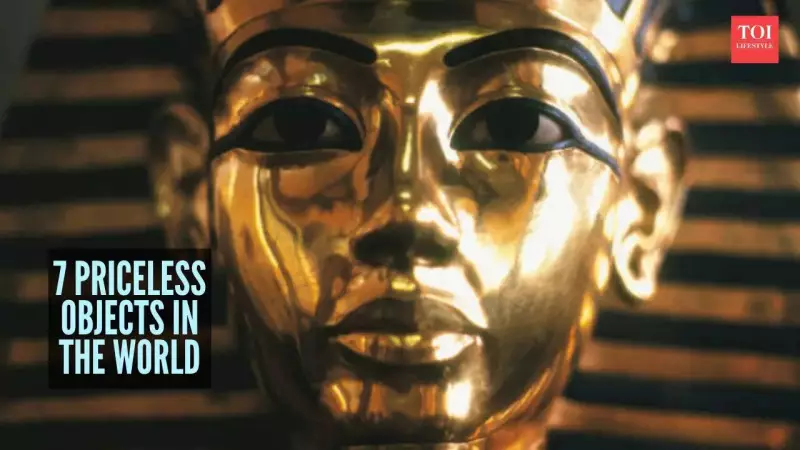
From ancient Egypt comes perhaps the most recognisable archaeological find: the solid gold funeral mask of Pharaoh Tutankhamun. Discovered in his tomb in the Valley of the Kings, the mask is an exquisite example of ancient Egyptian craftsmanship and religious belief. It is housed in the Egyptian Museum in Cairo and is deemed truly priceless, owing to its irreplaceable historical and cultural significance.
Priceless Historical Documents
Finally, the Dead Sea Scrolls represent a treasure of an entirely different kind. Discovered in the Qumran Caves near the Dead Sea, these ancient Jewish manuscripts date back over two millennia. They include some of the oldest known copies of biblical texts. Their value is not in a market price but in their incalculable historical, religious, and linguistic importance. While a few fragments have reached private collections, the majority are held in museums for preservation and study, offering an irreplaceable link to the past.
These seven objects, from the record-breaking Salvator Mundi to the invaluable Dead Sea Scrolls, remind us that humanity's greatest treasures are those that tell our shared story. Their worth is measured not just in currency but in their power to connect us to the creativity, beliefs, and lives of those who came before us.