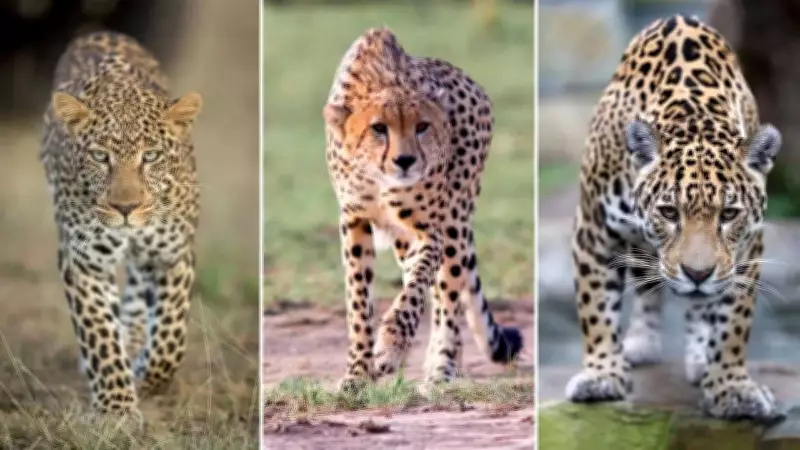
Many people cannot distinguish cheetahs, leopards, and jaguars at first glance because these large felines appear quite similar. Indeed, all three wild cats possess dark spots, are skilled predators, and share comparable sizes. However, it is crucial to recognize that these species differ in numerous aspects. Here are seven ways to help differentiate cheetahs, leopards, and jaguars.
Look at the Face
First, the most important clue for distinguishing these animals is their face. Specifically, a cheetah is easily identified by the tear marks under its eyes. This feature helps reduce sunlight glare while hunting. The faces of leopards and jaguars are much wider and heavier compared to that of the cheetah.
Notice Their Body Shapes
Second, there is a significant difference in body shapes. The cheetah has a lean and lightweight body with slender legs and a deep chest. The leopard's body is also rather wide, while the jaguar appears extremely massive and heavy in comparison. According to wildlife experts, the jaguar is considered the "power lifter" of wild cats due to its extremely strong neck, powerful jaws, and muscular shoulder girdle.

Note Differences in Spots
Third, although all cats have dark spots, the patterns are quite distinctive. Cheetahs have separate black spots scattered all over the body. Leopards are covered with spots forming rosette patterns. Jaguars have larger rosette-shaped spots with additional small spots inside each rosette. Thus, it is simple to identify a jaguar and leopard once you learn this feature.
Compare Geographical Locations
Another distinguishing factor is geographical location. Cheetahs inhabit African grasslands and open savannas. Leopards have diverse habitats and can be found almost everywhere in parts of Africa and Asia, including forests, mountain areas, and semi-deserts. Jaguars live in Central and South American rainforests, wetlands, and river basins.
Consider Differences in Hunting Style
Fourth, each cat has a unique hunting style. Cheetahs use high speeds exceeding 90 km/h to catch prey. Leopards rely on stalking skills and usually make sudden attacks after long stalking. Jaguars are skillful predators that use brute force; they possess one of the biggest bite forces in the world.
Compare Tail Length
Moreover, tail length differs. Cheetahs have very long and slender tails that assist in sudden turns while running fast. Leopards are known for climbing trees and have relatively long tails. Jaguars typically have short tails compared to their body weight.
Take Climbing and Swimming Skills into Account
Finally, consider tree climbing and swimming abilities. Leopards can carry heavy prey up trees to prevent theft. Jaguars are excellent swimmers, often living near swamps, lakes, and wetlands, and eating fish, turtles, and caimans. Cheetahs are not good at climbing trees.